
If you are planning a trip to New York City, Bethesda Terrace in Central Park is one place you simply cannot miss. Many visitors arrive at Central Park without knowing exactly where to go first. With so many paths and attractions spread across 843 acres, it is easy to feel overwhelmed. Bethesda Terrace gives you a clear, beautiful destination to head toward right from the start.
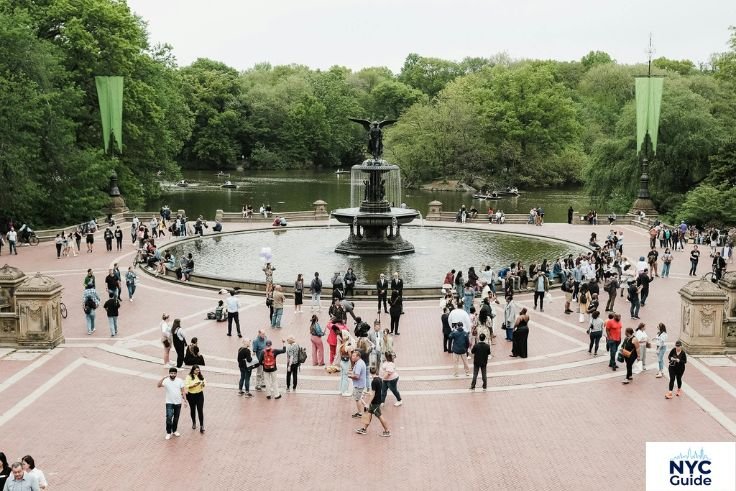
This guide will walk you through everything you need to know before you visit. From the history and architecture to the best time to go and what to do when you get there, it covers it all. Whether you are a first-time visitor or returning to New York, this complete guide will help you get the most out of your time here.
Bethesda Terrace is one of the most iconic spots in Central Park. It sits at the heart of the park, overlooking the scenic lake, and draws millions of visitors every year. Locals love it. Tourists photograph it. Filmmakers use it. And once you see it in person, you will understand exactly why.
What Is Bethesda Terrace?
Location Inside Central Park
Bethesda Terrace is located in the heart of Central Park, roughly at the midpoint of the park near 72nd Street. It sits at the southern end of The Lake and is easily accessible from both the east and west sides of Manhattan. The nearest cross streets are around 72nd Street and the Terrace Drive transverse. Most visitors reach it by walking south from The Ramble or north from the Bandshell and the Mall.
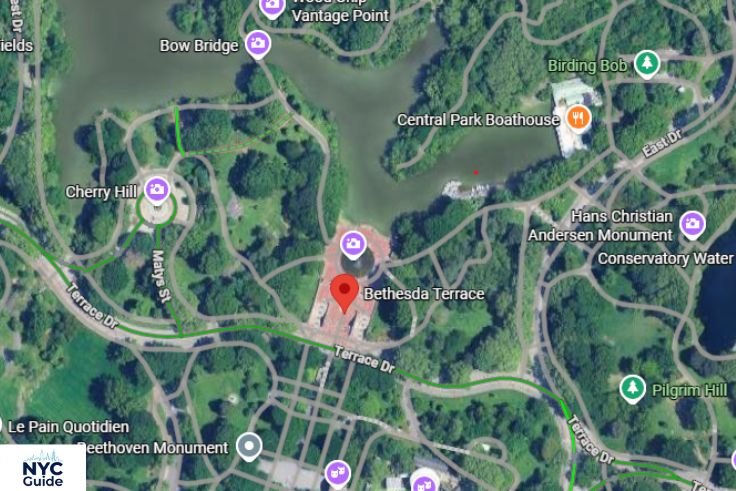
When I first visited, I entered from the East 72nd Street entrance and walked straight through the Mall, which is lined with elm trees. After about ten minutes of walking, the terrace opens up in front of you. The view is genuinely stunning, especially on a clear morning when the light reflects off the water.
Overview of the Terrace and Fountain
The terrace is a two-level outdoor space. The upper level is a wide open plaza where people gather, take photos, and enjoy views of The Lake. The lower level leads directly down to Bethesda Fountain, which is the centerpiece of the entire space. Between the two levels sits a covered passageway called the Arcade, which is one of the most beautifully decorated spaces in all of Central Park.
Bethesda Fountain itself is a large circular fountain with the famous Angel of the Waters statue rising from its center. The fountain is fully functional throughout most of the year, and watching the water spray in the open air with the lake behind it is one of those New York City experiences that stays with you.
History of Bethesda Terrace
Design and Construction
Bethesda Terrace was designed by Frederick Law Olmsted and Calvert Vaux as part of their original Greensward Plan for Central Park. The plan was selected in 1858 in a design competition, and construction on the terrace began in the 1860s. The full design was completed and opened to the public in 1873.
Olmsted and Vaux were very intentional about every element of Central Park. They believed that public green spaces had the power to improve the quality of life for city residents. Bethesda Terrace was conceived as the social and aesthetic centerpiece of the entire park, a place where all New Yorkers, regardless of class or background, could gather freely.
The Purpose Behind the Terrace
The terrace was not just meant to be beautiful. It was designed with a democratic purpose in mind. In the mid-1800s, New York was a rapidly growing and deeply divided city. Olmsted and Vaux wanted Central Park to serve as a great equalizer, a space where people of all walks of life could come together.
Bethesda Terrace was the only formal architectural feature in the original park design, which tells you just how important it was to the creators. Every other element of the park was designed to feel natural and informal. The terrace was the deliberate exception, a place of grandeur meant to make all visitors feel welcome and significant.
The Angel of the Waters Statue
Meaning Behind the Sculpture
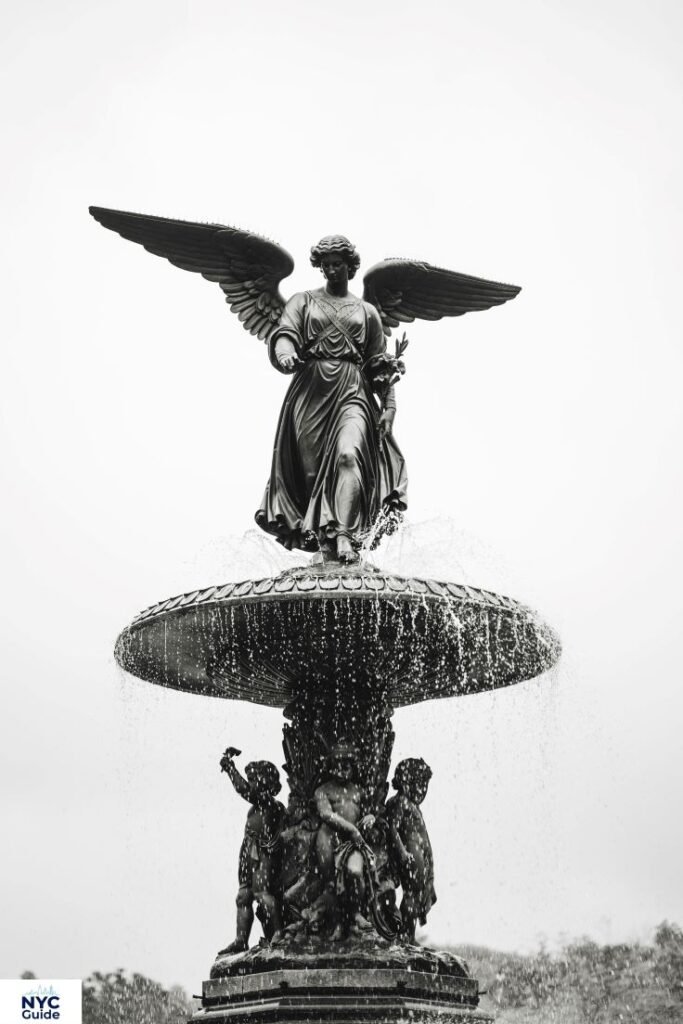
The Angel of the Waters statue stands at the top of Bethesda Fountain and is one of the most recognized pieces of public art in New York City. It was designed by sculptor Emma Stebbins and unveiled in 1873. Stebbins was the first woman to receive a major public art commission in New York City, which makes this statue historically significant in more ways than one.
The statue is based on a passage from the Gospel of John, specifically a reference to an angel who stirs the waters of the Pool of Bethesda in Jerusalem, granting healing to those who enter. The choice of this biblical imagery was also a tribute to the Croton Aqueduct, which had recently brought clean drinking water to New York City. Clean water was a matter of public health and survival at the time, and the fountain honored that achievement.
Artwork Details and Symbolism
The angel stands with wings spread and one hand raised, holding a lily. Below her are four smaller cherub figures that represent Temperance, Purity, Health, and Peace. Together, the full sculpture is a statement about the ideals the park was meant to embody.
The statue is made of bronze and has developed a beautiful green patina over the decades. It stands about eight feet tall, though the full fountain structure rises considerably higher. When you stand at the base of the fountain and look up at the angel, there is something genuinely moving about the combination of art, water, and open sky above you.
Architecture and Design of Bethesda Terrace
The Arcade and Ceiling Tiles
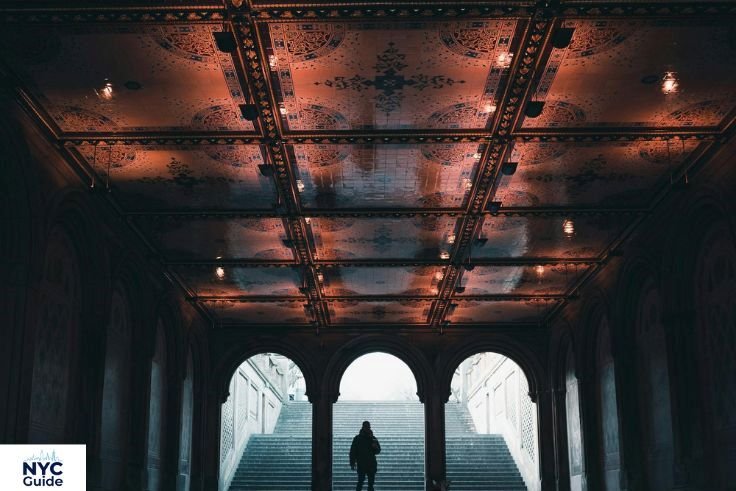
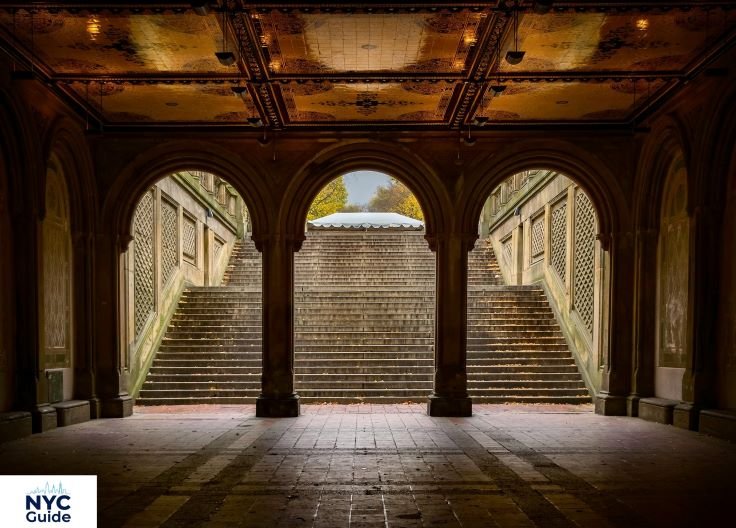
The Bethesda Arcade is the covered passageway that connects the upper and lower levels of the terrace. It runs beneath the upper plaza and opens out at both ends to provide a shaded walkway between the terrace steps and the fountain area below.
What makes the Arcade truly special is its ceiling. The entire ceiling is covered in intricate Minton encaustic tiles, which were manufactured in England and installed during the original construction. The tiles feature geometric and floral patterns in rich earth tones and are considered some of the finest examples of decorative tile work in the United States. Many visitors walk through quickly and miss the ceiling entirely. Do yourself a favor and stop, look up, and take your time.
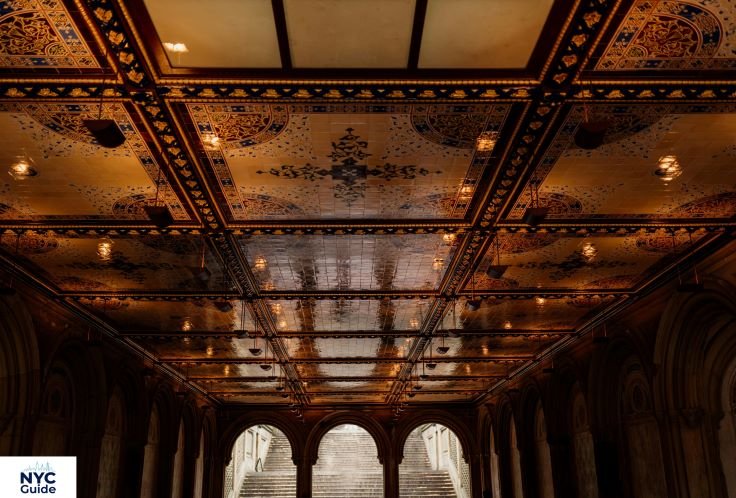
The walls of the Arcade also feature carved sandstone panels. The carvings include references to the four seasons, with birds, plants, and natural motifs representing spring, summer, autumn, and winter. The craftsmanship is extraordinary, and every panel is different.
The Fountain Area
Below the Arcade, the fountain plaza opens up into a wide, circular space. The fountain sits at the center, and The Lake stretches out behind it to the north. The area is paved with stone and ringed with benches where visitors can sit and take in the scene.
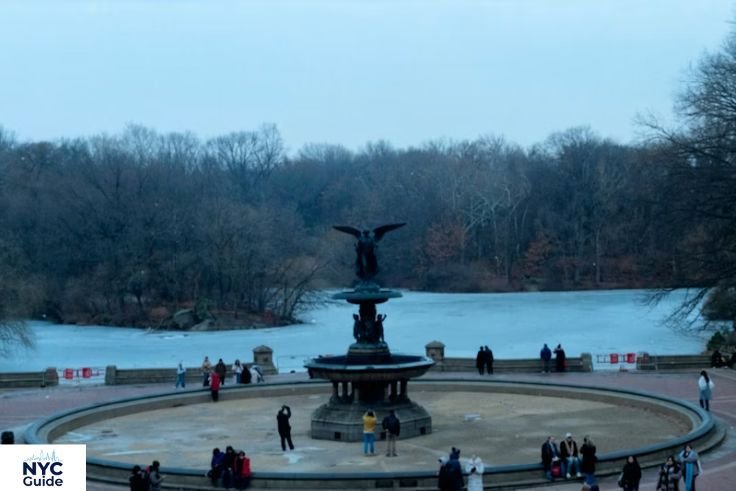
On warm days, the mist from the fountain reaches you gently as you stand close to it. Families gather here. Artists set up and sketch. Street musicians play. It feels like the whole city comes through at some point during the day.
Bethesda Terrace in Movies and Pop Culture
Bethesda Terrace has appeared in so many films and television shows that it has become one of the most recognized outdoor locations in American cinema. Its dramatic, open architecture and timeless beauty make it a natural choice for filmmakers looking for a New York backdrop that feels both grand and authentic.
The terrace and fountain appeared in the 1990 film Home Alone 2: Lost in New York, in which Kevin McCallister is seen feeding pigeons near the fountain. That scene helped cement the location in the pop culture memory of an entire generation.
It has also appeared in films such as Enchanted, where the fairy tale princess dances near the fountain with the people of New York. The location works perfectly for that kind of magical sequence because the fountain and terrace already feel somewhat fantastical in real life. Other notable appearances include sequences in Angels in America, Nanny McPhee Returns, and numerous music videos and commercial shoots.
The terrace is also a beloved location for TV productions. It has appeared in several episodes of Law and Order, as well as in romantic comedies and dramatic series set in New York. On any given day, you might see a film crew setting up nearby. I once stumbled into a photo shoot during a midweek afternoon visit, with models in formal wear positioned near the fountain. It felt perfectly natural in that setting.
What Makes Bethesda Terrace Special
Public Space Design
What Olmsted and Vaux created at Bethesda Terrace is a masterclass in public space design. The layout uses levels, water, architecture, and natural surroundings to create a space that feels both intimate and expansive at the same time. You can stand on the upper terrace and feel like you are surveying a grand landscape. You can sit by the fountain and feel tucked away from the city.
The transition between the upper level and the lower fountain level is handled beautifully. The staircases on either side of the Arcade are wide and gently curved. They invite you to slow down and take in the view as you descend. Every design choice seems to have been made with the visitor’s experience in mind.
Uses and Activities
People use Bethesda Terrace in dozens of different ways. Some come for quiet contemplation by the water. Others come to meet friends or celebrate birthdays. Yoga groups gather on the upper plaza in the mornings. Street performers, musicians, and artists work the area throughout the day. Photographers come at every hour in search of the perfect light.
On weekends, the space buzzes with energy. You might find a jazz musician playing near the fountain, a group of inline skaters weaving through the plaza, or a crowd gathered to watch a street magician. The terrace supports all of it without ever feeling cluttered or chaotic.
Sociability and Atmosphere
One of the most remarkable things about Bethesda Terrace is how naturally social it is. The design seems to encourage people to linger, to make eye contact, to start conversations. When I visited on a Sunday afternoon in autumn, I ended up talking to a retired architect who had been coming to the terrace for thirty years. He pointed out details in the sandstone carvings I never would have noticed on my own.
The atmosphere shifts throughout the day. Mornings are calm and almost meditative. Late mornings bring families with young children. Afternoons are the busiest, with a full mix of visitors and locals. Evenings, especially in summer, can feel almost festive, with music carrying across the water.
Renovation and Restoration
Major Restoration Projects
Bethesda Terrace has undergone several significant restoration efforts over the decades. By the 1970s, Central Park had fallen into serious disrepair due to budget cuts and neglect. The terrace suffered vandalism, deterioration of the sandstone carvings, and damage to the Arcade tiles. The fountain was even turned off for a period during this time.
The founding of the Central Park Conservancy in 1980 marked a turning point. The Conservancy, a nonprofit organization that manages the park in partnership with the city, undertook a comprehensive restoration of Bethesda Terrace over the following years. The Minton tiles in the Arcade were cleaned, repaired, and in some areas replaced with period-accurate reproductions. The sandstone carvings were stabilized and restored. The fountain was fully repaired and returned to operation.
A major milestone was the full restoration of the Arcade ceiling, completed in the early 1980s. At that time, thousands of individual tiles were assessed, removed, cleaned, and reinstalled. The work required specialized craftspeople and was considered one of the most complex historic restoration projects in New York City at the time.
Public Involvement
The Central Park Conservancy has always involved the public in its restoration work. Fundraising campaigns, volunteer days, and public awareness programs have helped maintain the terrace and the broader park for decades. The Conservancy raises the majority of its operating funds through private donations, which means that contributions from individuals and foundations directly support the preservation of Bethesda Terrace.
If you care about the preservation of historic public spaces, consider making a donation to the Central Park Conservancy when you visit. The work they do is genuinely extraordinary, and the terrace is living proof of what sustained investment in public spaces can achieve.
Things to Do at Bethesda Terrace
Photography
Bethesda Terrace is one of the most photographed locations in NYC, and it is easy to see why. The combination of the fountain, the angel statue, the Arcade, and the lakeside backdrop offers enormous visual variety in a compact space. You could spend an entire morning here and never run out of interesting shots.
The golden hour just after sunrise offers soft, warm light that brings out the tones in the sandstone carvings beautifully. Midday light can be harsh, but it makes the water of the fountain sparkle. Overcast days actually work very well for architectural photography because the diffuse light eliminates harsh shadows.
Tips for photographers: get there early to avoid crowds, use the Arcade ceiling as a subject in its own right, and walk around to the lakeside for a wider perspective that includes the boathouse in the background.
Street Performances
The lower fountain plaza is one of the best spots in New York City to catch spontaneous street performances. Musicians set up here regularly, from classical guitarists to jazz groups to a capella singers. The circular shape of the fountain area creates natural acoustics that make even a solo performer sound full and rich.
One of my favorite memories of the terrace is sitting on the edge of the fountain basin on a warm October afternoon listening to a small brass quartet play for about forty-five minutes. A crowd gathered gradually, staying longer than they had planned. Nobody seemed to want to leave. That is exactly the kind of moment this space is designed to create.
Relaxing by the Fountain
Sometimes the best thing to do at Bethesda Terrace is simply nothing at all. Sitting on the broad stone steps that lead to the fountain, or on one of the benches around the fountain plaza, with the sound of the water in the background and The Lake stretching out ahead of you, is one of the most restorative experiences New York City has to offer.
Bring a book, bring a snack from one of the nearby food carts, or just sit and watch people go by. The terrace rewards those who slow down. One mistake many visitors make is rushing through to see the fountain quickly before moving on. Give yourself at least thirty to forty-five minutes here, and you will leave feeling like you actually experienced it.
Visiting Bethesda Terrace
Best Time to Visit
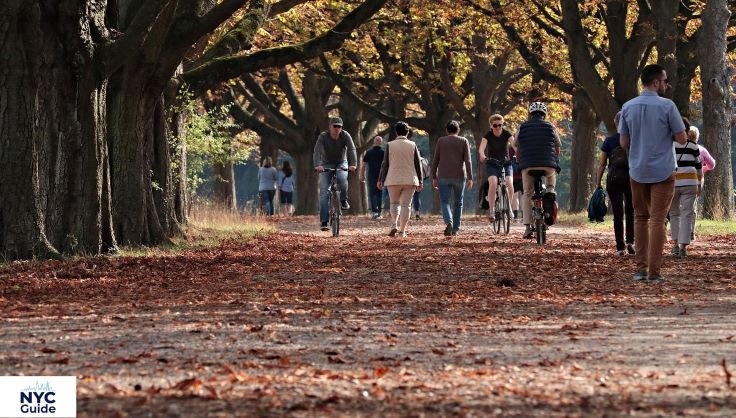
The best time to visit Bethesda Terrace depends on what kind of experience you are looking for. Spring and autumn are widely considered the ideal seasons. In spring, the surrounding trees and plantings are lush and blooming, and the weather is mild. In autumn, the foliage around The Lake turns brilliant shades of orange and gold, making the fountain backdrop especially dramatic.
Summer is the busiest season. The terrace is full of life and energy, which is wonderful, but it can also be crowded. If you visit in summer, aim for early morning on a weekday for the best combination of pleasant weather and manageable crowds.
Winter visits have their own magic. On clear winter mornings, the terrace can feel almost empty, and the fountain and architecture take on a spare, monumental quality. The fountain may be turned off in the coldest months, but the architecture and the lake view are just as compelling without it.
How to Get There
Bethesda Terrace is easily accessible by subway. The closest stations are the 72nd Street stations on the B and C lines (Central Park West entrance) and the 6 line (Lexington Avenue entrance at 68th Street). From either entrance, follow the park paths south toward the Mall and the terrace.
You can also take the 1, 2, or 3 trains to 72nd Street on the west side, or the Q train to 72nd Street on the east side. There are no entrance fees for Central Park, and the terrace itself is completely free to visit.
If you are walking from Midtown, the park is about a ten to fifteen minute walk from Times Square. Many visitors combine a walk up through the park with a stop at the terrace as part of a longer afternoon itinerary.
Nearby Attractions
Once you are at Bethesda Terrace, a number of other Central Park highlights are within easy walking distance. The Loeb Boathouse is just a short walk along the eastern shore of The Lake and offers rowboat rentals and waterside dining. Strawberry Fields, the memorial to John Lennon, is a ten-minute walk to the west. The Bandshell and the Mall are immediately to the south of the terrace and offer their own architectural and cultural interest.
To the north, a walk around The Lake leads to The Ramble, a forested area that is beloved by birdwatchers. Bow Bridge, one of the most photographed spots in Central Park, is also just a few minutes north of the terrace and offers stunning views across the water back toward the fountain.
Why Bethesda Terrace Is One of Central Park’s Most Famous Spots
There are hundreds of beautiful places in Central Park. But Bethesda Terrace holds a special position among them that goes beyond simple beauty. It combines architectural grandeur, historic significance, artistic achievement, and natural setting in a way that no other spot in the park quite matches.
The terrace was designed to be the emotional and visual climax of Central Park, the place you arrive at after walking through the Mall and feel that you have reached somewhere meaningful. After more than 150 years, it still delivers on that promise. The Angel of the Waters looks the same as she did in 1873. The Minton tiles still glow in the light of the Arcade. The fountain still runs.
What is perhaps most remarkable is that Bethesda Terrace remains free and open to everyone. In a city where access to beauty often comes with a price tag, the terrace is a genuine public treasure. Anyone can come here. Anyone can sit by the fountain, listen to music, take photographs, or simply watch the light change on the water. That democratic openness is exactly what Olmsted and Vaux intended when they built it, and it is exactly what makes it worth visiting again and again.
Frequently Asked Questions
Where exactly is Bethesda Terrace in Central Park?
Bethesda Terrace is located in the center of Central Park, near 72nd Street, at the southern end of The Lake. It is accessible from both the east and west sides of the park and is a short walk from several subway stations.
Is there an entrance fee for Bethesda Terrace?
No. Bethesda Terrace and Central Park are completely free to visit. There is no admission charge at any time of year.
What is the Angel of the Waters statue?
The Angel of the Waters is the bronze statue at the top of Bethesda Fountain. It was sculpted by Emma Stebbins and unveiled in 1873. It depicts an angel standing over four smaller figures that represent Temperance, Purity, Health, and Peace.
When is the best time to visit Bethesda Terrace?
Spring and autumn offer the most pleasant weather and the most beautiful natural surroundings. For smaller crowds, visit on a weekday morning. Summer is lively but busy. Winter mornings are quiet and atmospheric.
Who designed Bethesda Terrace?
Bethesda Terrace was designed by Frederick Law Olmsted and Calvert Vaux as part of their Greensward Plan for Central Park, which was selected in 1858. Construction was completed and the terrace opened in 1873.
Final Thoughts
Bethesda Terrace is the kind of place that rewards you every time you visit. Whether it is your first time standing at the fountain or your fiftieth, there is always something new to notice, a detail in the carvings, a change in the light, a musician you have never heard before. It is one of those rare public spaces that genuinely delivers on its promise of being a peaceful place to relax in Central Park, and it does so for free, for everyone, every single day.