
If you’ve ever wandered through Central Park wondering where all the peace and quiet went, the Conservatory Garden in Central Park might be exactly what you’ve been missing. Tucked away on the northeastern edge of the park at 105th Street and Fifth Avenue, this six-acre formal garden feels like a completely different world from the busy paths and joggers just steps away. I visited on a warm May morning and couldn’t believe I’d waited so long to discover this place.
Many visitors skip this corner of the park simply because they don’t know it exists. But once you step through those iconic Vanderbilt Gate doors, you’ll understand why locals call it one of the best-kept secrets in Manhattan. From picture-perfect flower beds to serene fountains and impeccable landscaping, this guide will tell you everything you need to know to make the most of your visit.
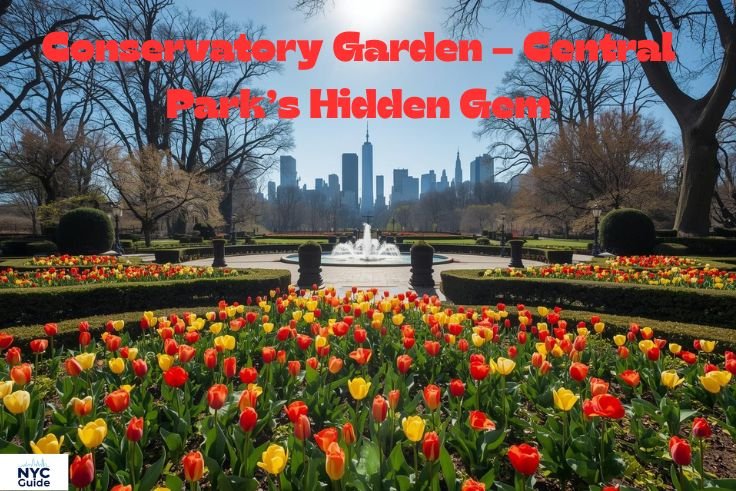
Whether you’re a first-timer searching for quiet places in Central Park, a photographer chasing perfect light, or a couple looking for a romantic garden in New York City, this guide covers it all. We’ll walk you through every section of the garden, the best bloom times, tour details, and tips to be a respectful visitor.
Conservatory Garden
The Conservatory Garden is the only formal garden in all of Central Park, and that distinction alone makes it worth seeking out. While the rest of the park embraces a naturalistic English landscape style, this six-acre retreat is divided into three distinct garden rooms, each inspired by a different European gardening tradition. It sits along the park’s eastern edge between 104th and 106th Streets, bordered by Fifth Avenue.
The garden gets its name from a large glass conservatory that once occupied this space in the early 1900s. That greenhouse was demolished in 1934, but the Central Park Conservancy restored the garden in the 1980s after years of neglect. Today, it’s maintained to the highest standard and serves as one of the most photographed and beloved spots in all of New York City.
Enjoy a Stroll Through the Italian, English and French-Style Gardens
One of the most impressive things about this space is that you actually get three garden experiences in one visit. The garden is divided into a North Garden, Central Garden, and South Garden each with its own personality, planting style, and focal point. Walking through all three feels like a mini tour of European horticultural traditions, right in the heart of Manhattan.
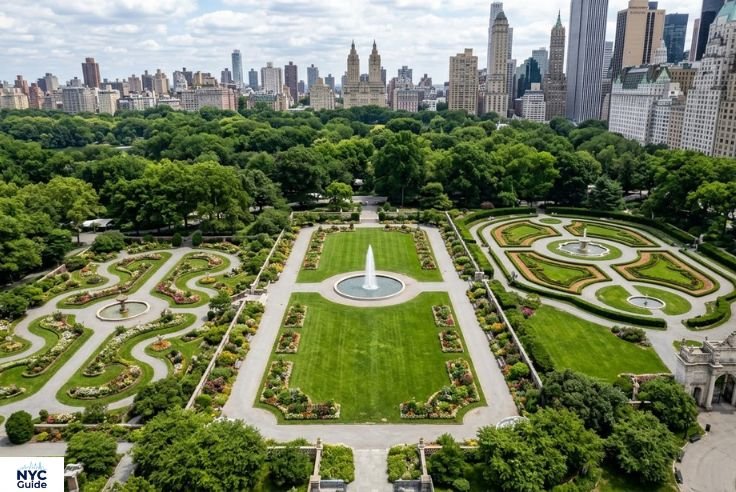
Spend at least 45 minutes here if you want to appreciate every section without rushing. If you’re visiting during peak bloom in May or June, set aside an hour or more. Every path, bench, and planting bed has been thoughtfully designed to reward slow, unhurried exploration.
The North Garden
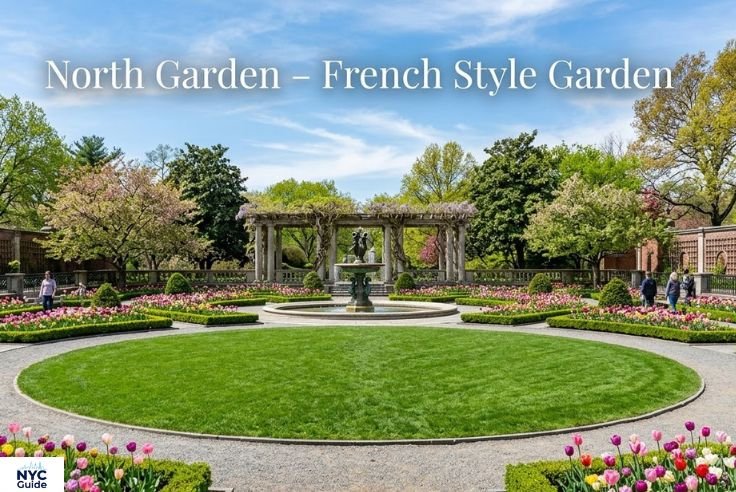
The North Garden is the French-style garden in Central Park and it’s the first area most visitors encounter after entering through the Vanderbilt Gate. It’s laid out in a formal, symmetrical pattern with a large circular lawn at its center, ringed by precisely trimmed hedges and seasonal plantings.
In spring, this section bursts with thousands of tulips in every imaginable color. By summer, the beds transition to annuals like salvia and begonias that maintain that vivid, manicured look right through fall. There’s also a stunning wisteria pergola nearby that frames the entrance in lavender cascades during early May one of the most beautiful sights in all of central park sightseeing spots. When I visited during tulip season, the North Garden genuinely stopped me in my tracks. I must have taken 50 photos before even leaving this section.
The Central Garden
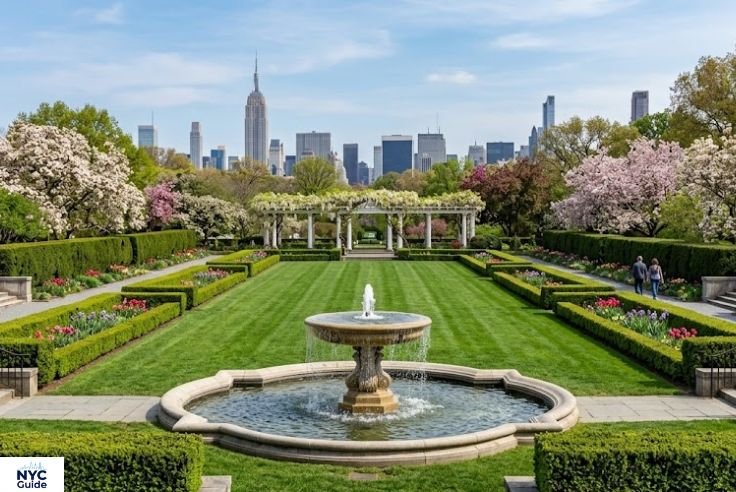
The Central Garden is the Italian-style garden in Central Park, and it forms the grand centerpiece of the entire space. A long, elegant lawn stretches out from the main entrance path, flanked by classical yew hedges that are trimmed to perfection. At the far end stands the ornate Conservatory Garden Center Fountain.
The great lawn here is actually used for occasional outdoor events and weddings, which gives you a sense of just how elegant this space is. The symmetry and scale of the Italian garden feel genuinely majestic. This is the section that most often appears in engagement photos and editorial shoots and it’s easy to see why.
The South Garden
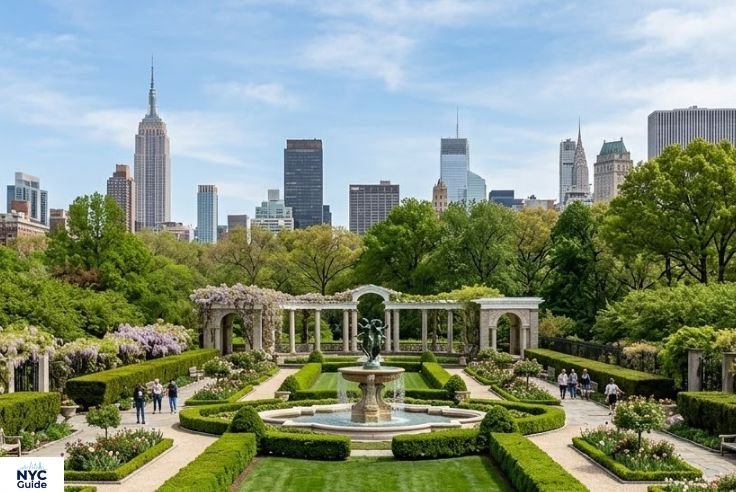
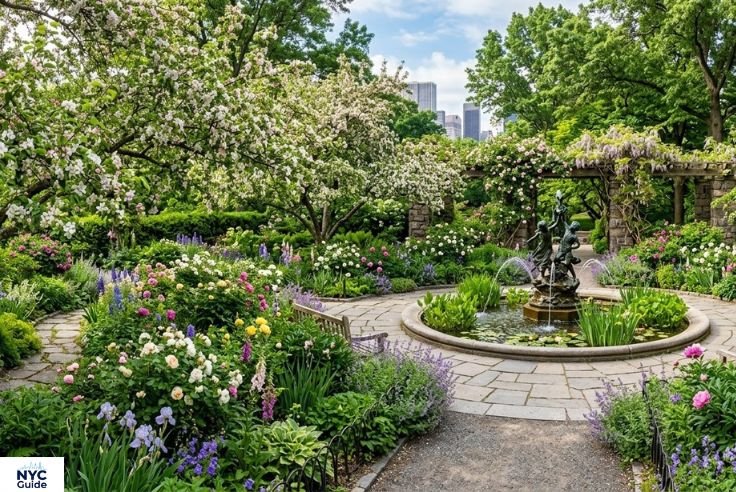
The South Garden is the English-style garden central park visitors most often describe as the most intimate and romantic of the three. It features a more naturalistic layout compared to the structured French and Italian sections, with winding paths through perennial beds that bloom in waves from spring through fall.
At the heart of the South Garden sits the beloved Burnett Fountain, surrounded by flowering crabapple trees and lush plantings. This area feels personal and secluded, like a private garden you’ve stumbled into by happy accident. It’s the quietest of the three sections and a perfect place to sit, read, or simply breathe for a moment.
Park Features
Area
The Conservatory Garden covers approximately six acres, making it large enough to feel spacious but intimate enough to explore thoroughly in a single visit. It’s located in the northeastern section of Central Park, accessible via Fifth Avenue at 105th Street. The address is 830 Fifth Avenue, New York, NY 10065.
| Location | Fifth Avenue & 105th Street, Central Park, Manhattan |
| Total Area | 6 acres (3 distinct garden sections) |
| Nearest Subway | 6 train to 103rd St or 110th St |
| Managed by | Central Park Conservancy |
| Admission | Free to the public |
Park Hours
The Conservatory Garden is open daily from 8:00 AM to dusk, year-round. Admission is completely free there are no tickets, no reservations needed, and no crowds at a gate. The Vanderbilt Gate, the main entrance on Fifth Avenue, is the official entry point. A secondary entrance exists at 106th Street on the north side.
One important tip: the garden does close at dusk, and rangers will ask visitors to leave. We learned this the hard way once, arriving at 6:30 PM in October and only having about 30 minutes before being gently ushered out. Plan to arrive well before sunset if you want to spend real time here.
Activities & Amenities
The garden is primarily a space for quiet enjoyment, but there’s quite a bit to do here beyond simply looking at flowers. Benches are positioned throughout for restful sitting and people-watching. Photography is popular and encouraged. Guided tours are also available (more on that below).
Things to do near the Conservatory Garden include visiting the nearby Museum of the City of New York, the El Museo del Barrio, and the Jewish Museum, all within a short walk along Fifth Avenue. The garden itself has no food vendors, so bring a snack if you plan a long visit. Restrooms are located nearby in the park.
Things You’ll See in Conservatory Garden
Beyond the flowers and greenery, several specific landmarks within the garden are worth seeking out. Each has its own history and visual character, and together they give the garden much of its distinctive personality.
Burnett Fountain
The Burnett Fountain is the centerpiece of the South Garden and one of the most charming sculptures in all of Central Park. It depicts two characters from Frances Hodgson Burnett’s classic novel The Secret Garden a young girl and a boy with a bird. The bronze figures were created by sculptor Bessie Potter Vonnoh and installed in 1937 as a tribute to the beloved author.
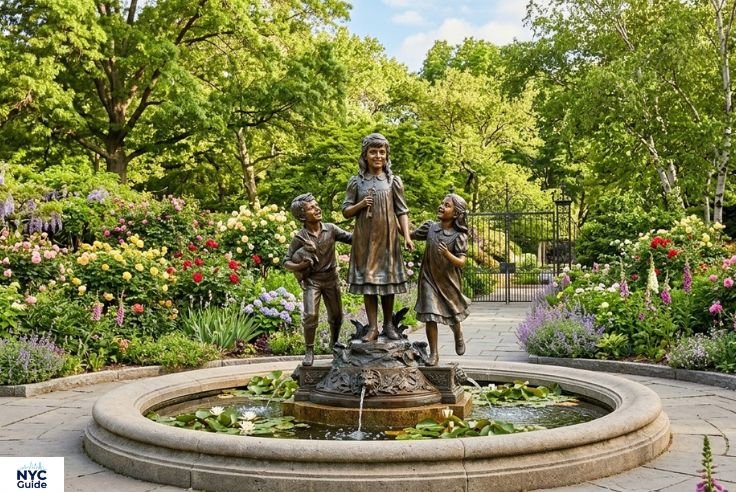
The fountain sits within a circular reflecting pool surrounded by flowering plantings that mirror the seasonal palette of the garden. If you’ve ever read The Secret Garden, standing here feels genuinely moving. Even if you haven’t, it’s simply beautiful. This is one of those hidden gardens in central park moments that visitors never forget.
Untermyer Fountain
The Untermyer Fountain anchors the North Garden and features three bronze dancing maidens surrounding a central water jet. It was donated by Samuel Untermyer in 1947 and designed by sculptor Walter Schott. The figures are often called the Three Dancing Maidens and represent an elegant, joyful energy that contrasts beautifully with the formal symmetry of the French-style beds around them.
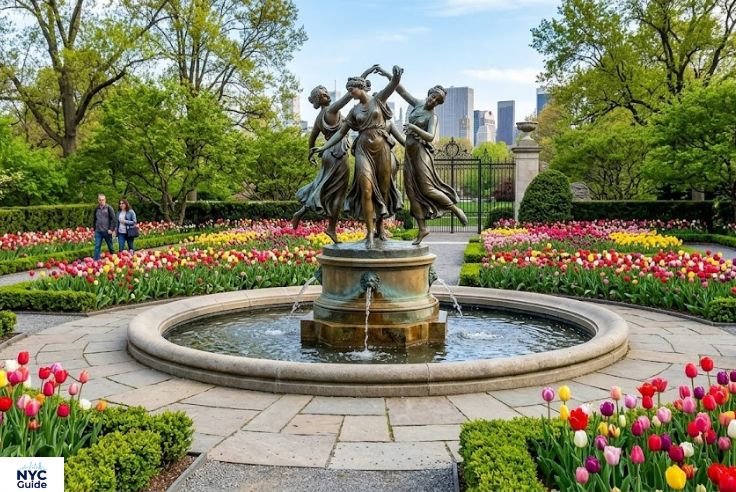
The fountain is especially photogenic in late spring when the surrounding tulip beds are in full bloom. On sunny days, the light hitting the bronze figures against the green hedgerows creates an almost painterly scene. It’s one of those spots where you’ll want to linger longer than expected.
Conservatory Garden Center Fountain
At the far end of the Central Garden’s Italian-style lawn, the Center Fountain provides a classical focal point that draws the eye down the length of the great lawn. Its simple, elegant design complements the formal structure of the Italian garden without overpowering it.
This fountain makes an ideal backdrop for photos and is a natural gathering point for visitors coming from the Vanderbilt Gate entrance. The alignment between the gate, the lawn, and the fountain is precise and intentional a classic Italian garden axis that creates a satisfying sense of arrival.
Vanderbilt Gate
The Vanderbilt Gate is the grand main entrance to the Conservatory Garden on Fifth Avenue at 105th Street. This stunning wrought-iron gate was originally made in Paris in the early 1900s and once stood at the mansion of Cornelius Vanderbilt II on 58th Street and Fifth Avenue. It was donated to the park in 1939 when the mansion was demolished.
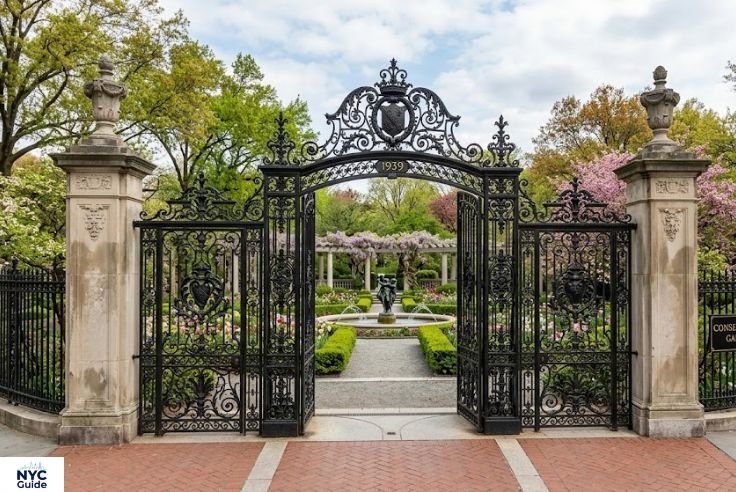
The gate alone is worth the trip. The intricate ironwork depicts intertwined floral motifs and is flanked by stone pillars. Arriving through the Vanderbilt Gate sets the tone for the whole experience you immediately feel like you’re stepping into something special. It’s also the most popular spot for photos before entering the garden itself.
Conservatory Garden Bloom Guide
One of the biggest questions visitors ask is: when do the flowers bloom in Central Park’s Conservatory Garden? The answer is that something is almost always blooming here from early spring through late fall. The Central Park Conservancy’s horticulture team plants the garden in carefully coordinated waves to ensure continuous color throughout the season.
Conservatory Garden Bloom Schedule
Use this bloom schedule as a general guide exact timing varies by year and weather conditions, but the patterns are consistent from season to season.
| Month | What’s Blooming | Color Palette |
| April | Forsythia, cherry blossoms, tulips (early) | Yellow, pink, white |
| May | Tulips, wisteria, crabapple, allium | Purple, red, orange, pink |
| June | Roses (peak), peonies, baptisia | Deep red, blush, lavender |
| July | Daylilies, black-eyed Susans, salvia | Yellow, orange, blue |
| August | Late perennials, rudbeckia | Gold, bronze, warm tones |
| September | Asters, ornamental grasses | Purple, silver-green |
| October | Autumn foliage, witch hazel | Russet, amber, gold |
When Do the Flowers Bloom in Central Park?
The best time to visit Conservatory Garden is between late April and mid-June, when tulips, wisteria, crabapple blossoms, and roses overlap in a breathtaking display. May is generally considered the peak month. Roses in the South Garden typically hit full bloom in early to mid-June, making that a second strong window.
If you’re visiting outside of spring, don’t be discouraged. The garden is still beautiful in summer with its perennial plantings, and the autumn foliage adds warm, painterly tones to the landscape.
Color
The color palette of the Conservatory Garden shifts dramatically through the seasons. Spring brings cool pastels blush pinks, soft purples, buttery yellows, and crisp whites creating a delicate, almost dreamlike atmosphere. Summer intensifies the palette with deeper oranges, reds, and electric blues from salvia and coneflowers.
The South Garden in particular is designed around complementary color relationships, with warm and cool tones placed near each other to create visual depth. The Central Park Conservancy’s horticulture team approaches the planting like artists composing a canvas.
Texture
Beyond color, the garden’s designers use texture masterfully. The contrast between fine-textured ornamental grasses and bold-leafed hostas, or between the airy plumes of astilbe and the dense mounding of boxwood hedges, creates visual interest at every level. Even when bloom is not at peak, the layered textures of the plantings make the space engaging and dynamic.
Shape and Form
The formal structure of the garden its clipped hedges, geometric lawn shapes, and precise pathways provides a strong architectural backbone that supports the softer plantings. Even in winter, when most flowers are gone, the garden retains its beauty through the sculptural forms of the trimmed yews, bare tree silhouettes, and the elegant lines of the ironwork fences and fountains.
Conservatory Garden Tour
The Central Park Conservancy offers guided tours of the Conservatory Garden led by knowledgeable volunteer guides. These free tours are a wonderful way to deepen your appreciation for the garden’s history, horticulture, and design. My friends who joined one of these tours came away knowing so much more about what they were looking at and they’d already visited the garden twice on their own.
Tour Length
Guided tours typically run about one hour. Self-guided exploration takes anywhere from 30 to 90 minutes depending on how slowly you walk and how many photos you stop to take. I’ve spent a full two hours here during peak bloom without feeling like I’d overstayed.
Starting Location
Tours start at the Vanderbilt Gate entrance on Fifth Avenue and 105th Street. Arrive a few minutes early to meet the group. Check the Central Park Conservancy website for current tour schedules, as times may vary seasonally. Tours are typically offered on weekend mornings during the spring and fall months.
Terrain
The garden is mostly flat and paved with smooth gravel and stone paths, making it accessible and comfortable for most visitors. Some areas have gentle slopes, but there are no steep hills. The paths are wide enough for strollers and are generally wheelchair-friendly, though those using mobility aids should check the Central Park Conservancy’s accessibility information for the most current details.
Type of Activity
This is a leisurely walking and sightseeing experience. It’s not a physically demanding activity this is a place for slow strolling, pausing, sitting, and absorbing the beauty around you. It’s ideal for families with young children, seniors, couples, and anyone who simply wants a peaceful break from the city’s intensity.
5 Reasons to Visit the Central Park Conservatory Garden in Spring
If you’re planning a trip to New York in spring, here’s why putting the Central Park Conservatory Garden on your itinerary is a genuinely great idea:
• Tulip season is spectacular: The North Garden comes alive in May with thousands of tulips, creating a colorful display that rivals many European botanical gardens — and it’s completely free to enjoy.
• Wisteria in full bloom: Near the entrance stands the famous wisteria pergola, one of the most photographed spots among Central Park gardens in NYC. It reaches peak bloom for only a few weeks each spring.
• Peaceful mornings: If you visit in the morning during spring, the garden usually feels calm and crowd-free, especially on weekdays. The light is soft and perfect for photography.
• Perfect for a picnic or a slow walk: The benches, lawns, and shaded paths make this an ideal spot to slow down and spend a morning or early afternoon without any agenda.
• Romantic atmosphere: Whether you’re planning a proposal, a first date, or just an anniversary stroll, few places in New York City offer a more genuinely romantic setting than the spring Conservatory Garden.
How to Make a Positive Impact as a Tourist in New York
The Conservatory Garden is a free, publicly maintained space that depends on respectful visitors to stay beautiful. Here’s how to enjoy it while being a responsible guest:
• Stay on the paths: Stepping into the flower beds even for a photo damages the plants and the soil. Every single planting has been carefully placed. Respect the beds.
• Take nothing: Picking flowers or removing any plant material is strictly prohibited and genuinely harmful to the garden’s integrity.
• Keep noise low: This is a quiet place in Manhattan, and many visitors come here specifically for the tranquility. Loud music, shouting, or disruptive behavior takes away from everyone’s experience.
• Support the Central Park Conservancy: The garden is maintained by the Central Park Conservancy, a nonprofit organization. Consider making a donation to help fund the ongoing care of this and other green spaces in the park.
• Carry out your trash: There are waste bins available, but every piece of litter you take with you makes a difference.
• Bring only what you need: Large groups with bulky gear can inadvertently damage plantings or crowd narrow paths. Be mindful of the space.
Final Thoughts
The Conservatory Garden central park is not just another stop on a sightseeing checklist. It’s an experience quiet, beautiful, and unhurried in a city that’s rarely any of those things. Whether you’re a first-time visitor to New York or a longtime local who’s somehow never made the trip uptown, this garden deserves a proper visit.
I’ve been back three times now once in autumn, once in winter, and once during peak spring bloom. Each visit has felt entirely different and equally worthwhile. The garden changes with the seasons and rewards visitors who return. Pack a book, bring a camera, wear comfortable shoes, and give yourself more time than you think you’ll need. You won’t regret it.
Frequently Asked Questions
Is the Conservatory Garden free to visit?
Yes. The Conservatory Garden is completely free and open to the public every day from 8:00 AM to dusk. No tickets or reservations are required.
What is the best month to visit Conservatory Garden?
May is generally the peak month, when tulips, wisteria, and crabapple are all in bloom simultaneously. Early June is also excellent for roses. Spring overall (late April through June) is the most visually spectacular time.
Can you have a wedding at Conservatory Garden?
Yes, the Conservatory Garden is a popular wedding and engagement shoot location. The Central Park Conservancy permits certain events in the garden. Contact them directly for permit information and availability.
How do I get to the Conservatory Garden?
Take the 6 subway train to 103rd Street or 110th Street, then walk west into Central Park. The main entrance is the Vanderbilt Gate at Fifth Avenue and 105th Street. The M1, M2, M3, and M4 buses also stop along Fifth Avenue nearby.
Are dogs allowed in the Conservatory Garden?
Dogs are not permitted inside the Conservatory Garden, as the space requires a higher standard of care and protection for its plantings. This is one of the few areas of Central Park with this restriction.