
The Metropolitan Museum of Art is one of the largest and most visited museums in the world. With over two million works spread across more than 300 galleries, knowing where to start can feel overwhelming. A Metropolitan Museum of Art guided tour solves that problem by giving you structure, context, and a real sense of what you are looking at.
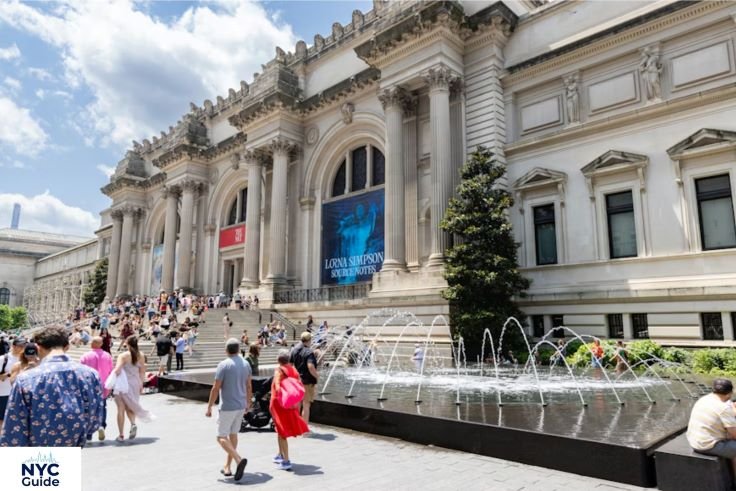
I still remember my first visit to the Met. I walked in without a plan and spent the first hour wandering in circles, not sure what to prioritize. It was only when I joined a highlights tour that things started to make sense. A good guide brings the art to life in a way that no map or pamphlet can match.
This guide covers everything you need to know before your visit. From tour types and ticket prices to must-see artworks and hidden gems, you will leave knowing exactly how to make the most of your time at the Met.
Why Take a Guided Tour at the Metropolitan Museum of Art?
The Met holds more than two million objects spanning five thousand years of history. Even a full day is not enough to see everything. That is exactly why a guided tour matters.
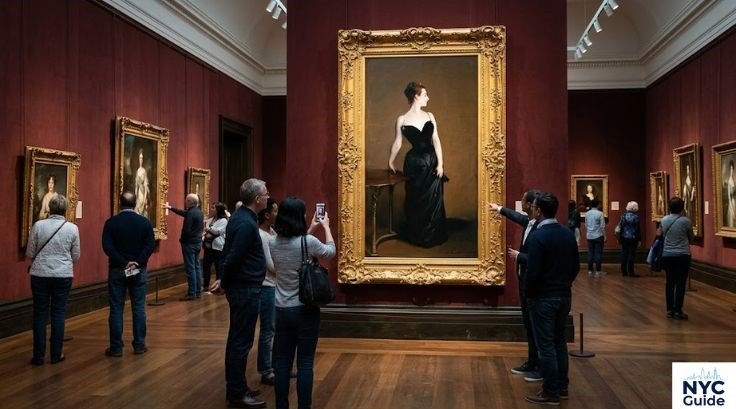
A knowledgeable guide helps you skip the confusion and focus on what truly counts. Instead of reading wall labels without context, you get real stories behind the works. You learn why Madame X . You understand what makes the Temple of Dendur so remarkable. You walk away with memories that actually stick.
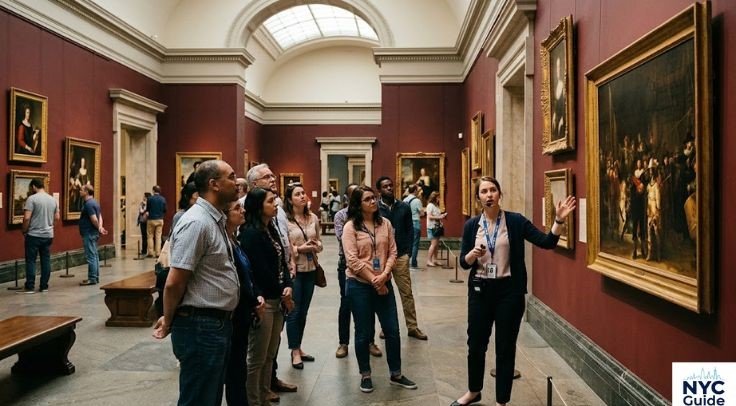
Guided tours also help you avoid the most common visitor mistake, which is trying to see everything. A good guide knows the best route, the least crowded times, and the details that make each artwork unforgettable. Whether you are a first-time visitor or returning for the fifth time, a tour adds a layer of understanding that transforms the experience entirely.
What to Expect on a Metropolitan Museum of Art Guided Tour
Most guided tours at the Met last between one and a half to three hours. Your guide will lead a small group through selected galleries. They will stop at key artworks, share background stories, and answer questions along the way.
You do not need any prior knowledge of art or history. Tours are designed for general audiences and are usually very welcoming. The pace is comfortable, with enough time to absorb each stop without rushing.
At the start of your tour, you will typically meet your guide near the main entrance on Fifth Avenue. Groups are usually kept small to maintain quality. You will not need to carry anything except your phone or a notebook if you want to take notes.
Types of Guided Tours Available at the Met
Highlights Tour
The highlights tour is the most popular option for first-time visitors. It covers the greatest works across multiple departments in around ninety minutes. You will see Egyptian art, European paintings, Greek and Roman sculptures, and American masterpieces all in one focused session. This is the best starting point if you are short on time.
Ancient Egypt Tour
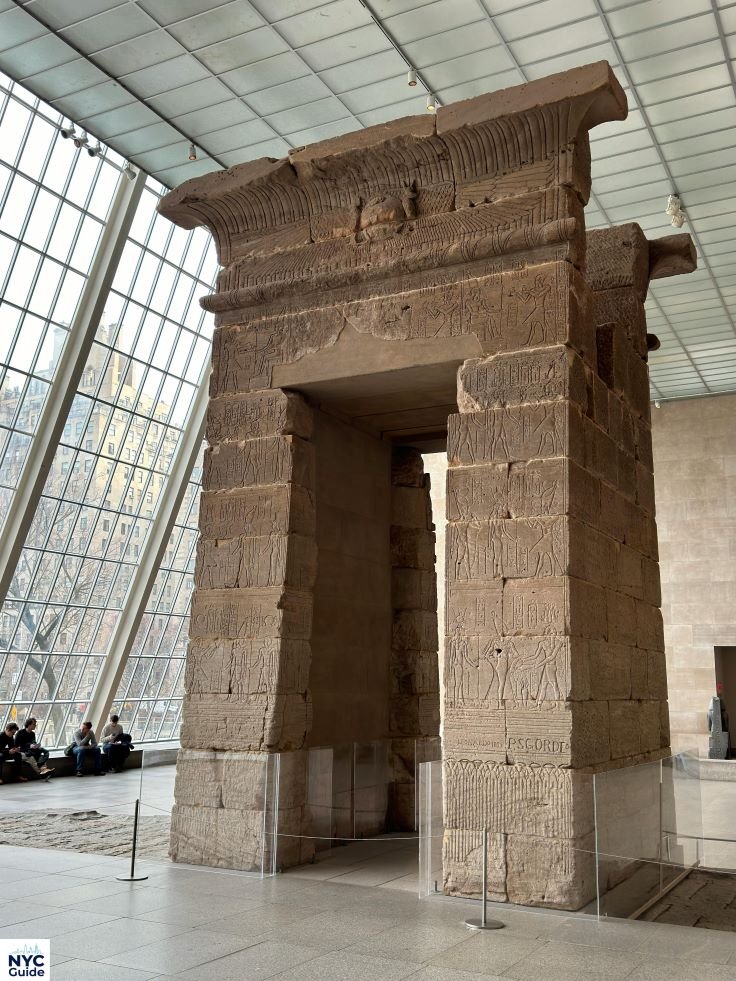
The Met holds one of the finest Egyptian art collections outside of Egypt. This tour takes you through thousands of years of ancient history. The centerpiece is the Temple of Dendur, a real ancient Egyptian temple that was gifted to the United States. You will also see jewelry, mummies, tomb models, and the famous blue hippo known as William.
European Paintings Tour
This tour focuses on the Met’s extraordinary European paintings collection. You will stand before works by Rembrandt, Vermeer, Velázquez, Monet, and Van Gogh. The guide will explain techniques, historical context, and the personal stories behind each painting. Art lovers tend to rate this tour as one of the most rewarding experiences at the museum.
American Wing Tour
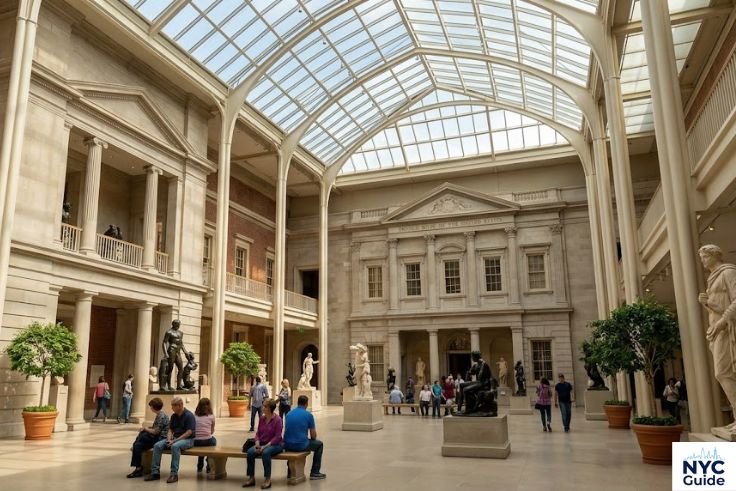
The American Wing is often overlooked by international visitors, which is a real shame. This tour covers American decorative arts, paintings, and sculptures from the colonial era to the early twentieth century. The beautiful glass-enclosed courtyard alone is worth the visit. Washington Crossing the Delaware is a highlight that never fails to impress.
Modern and Contemporary Art Tour
This tour explores the Met’s modern and contemporary collections. You will encounter works by Pablo Picasso, Jackson Pollock, and other giants of the twentieth century. The guide helps decode works that might seem confusing at first glance, turning abstract art into something genuinely exciting.
Family and Kids Tours
The Met offers specially designed tours for families with children. These tours use interactive storytelling and age-appropriate explanations to keep younger visitors engaged. Kids get to explore mummies, armor, and ancient artifacts in a way that feels like an adventure rather than a lesson.
Private VIP Tours
Private guided tours offer an exclusive, personalized experience. You work with a specialist guide who tailors the tour entirely to your interests. Private tours are ideal for special occasions, corporate groups, or anyone who wants undivided attention and flexibility. These tours require advance booking and come at a higher price point.
Self-Guided Audio Tours
If you prefer to explore at your own pace, the Met offers an official audio guide. You can rent a device at the museum or use the Met’s mobile app on your smartphone. The audio guide covers highlights across all major collections and is available in multiple languages.
Best Metropolitan Museum of Art Guided Tour Routes
2-Hour First-Time Visitor Route
Start at the Egyptian Art galleries and spend time with the Temple of Dendur. Move into Greek and Roman Art for the classical sculptures. Head upstairs to European Paintings to see Rembrandt, Vermeer, and Van Gogh. Finish in the American Wing Courtyard. This route gives you a strong cross-section of the museum without exhausting you.
Half-Day Met Museum Tour Route
Arrive when the museum opens at 10 AM. Begin with Egyptian Art, then move to Arms and Armor. Cross into Medieval Art before heading upstairs to European Paintings. Take a short break at the museum cafe. Spend your final hour in Modern and Contemporary Art. This route covers five major departments comfortably in around four hours.
Full-Day Met Museum Highlights Tour
A full day allows you to go deeper. Follow the half-day route in the morning. After lunch, add the Asian Art galleries, the Islamic Art wing, and the Astor Chinese Garden Court. If energy allows, finish with a visit to the rooftop garden, which offers spectacular views of Central Park. Allow yourself time to linger and revisit favorites.
Guided Tour for Families with Children
Start with Egyptian Art because children love mummies and artifacts. Move to Arms and Armor, which tends to be a crowd favorite for kids. Head to the American Wing and let them explore the period rooms. Finish with the Greek and Roman galleries. Keep stops short and build in a snack break around the two-hour mark.
Guided Tour for Art Lovers
Begin in European Paintings and take your time with each work. Move to Modern and Contemporary Art and spend at least forty-five minutes there. Visit the Asian Art galleries for a completely different aesthetic experience. Finish with the Drawings, Prints, and Photographs department if time allows. Art lovers should budget at least five to six hours.
Guided Tour for History Lovers
Start with the Ancient Near East galleries and the Cypriot collection. Move into Egyptian Art and spend extra time with the tomb models and temple. Continue through Greek and Roman Art. Visit Medieval Art and the Arms and Armor galleries. Finish with the American Wing for a journey through American history. Budget five hours for this route.
Best Time to Visit the Metropolitan Museum of Art
The Met is open Tuesday through Sunday. It is closed on Mondays and on certain holidays. Hours are typically 10 AM to 5 PM, with extended hours until 9 PM on Fridays and Saturdays.
The best time to visit is weekday mornings, ideally Tuesday through Thursday. Crowds are significantly lighter before noon. Weekends are busier, especially between 11 AM and 3 PM.
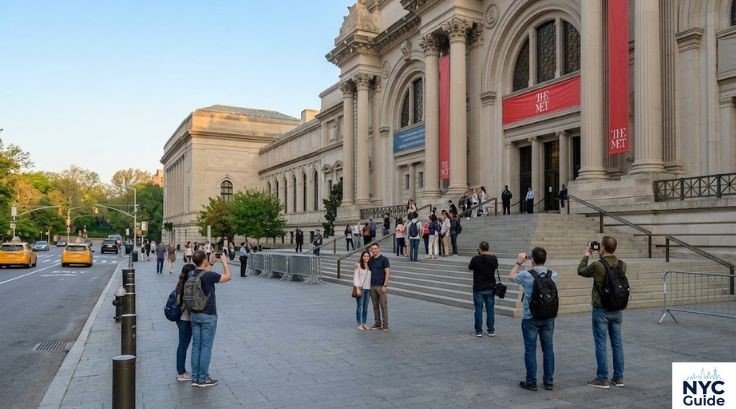
Spring and fall are the most pleasant seasons to visit. Summer brings large tourist crowds, particularly in July and August. If you visit in winter, you will find fewer crowds and a quieter atmosphere, especially after the holiday season ends in early January.
How Long Does a Met Museum Guided Tour Take?
Most standard guided tours run between ninety minutes and two and a half hours. Private tours can be customized to any length. If you book a highlights tour, expect around ninety minutes. Specialty tours focused on a single department usually run about two hours.
After the tour ends, many visitors stay independently to explore further. Plan for at least one additional hour of self-exploration if this is your first visit.
Metropolitan Museum of Art Tickets and Tour Prices
General admission to the Met costs $30 for adults, $22 for seniors aged 65 and above, and $17 for students. Children under 12 accompanied by an adult are admitted free. New York State residents and New York, New Jersey, and Connecticut students can pay what they wish.
Guided group tours offered directly through the museum are included with general admission for many programs. Private guided tours through third-party companies typically range from $50 to $150 per person depending on the tour length and group size. VIP private tours can cost $200 or more per person.
Audio guide rental at the museum costs around $7. The official Met mobile app is free to download.
Are Guided Tours at the Met Free?
Many of the Met’s own guided tours, including daily highlights tours and gallery talks led by museum educators, are included with general admission. You do not pay extra for these official tours.
Third-party guided tours and private tours booked through external companies carry additional fees. These tours offer more personalized experiences and often allow you to skip certain general entry lines.
Always check the Met’s official website before visiting for the most up-to-date schedule of free tours and educator-led gallery talks.
How to Book a Metropolitan Museum of Art Guided Tour
For official museum tours, no advance booking is required. You arrive, purchase your admission ticket, and check the daily tour schedule at the information desk near the main entrance. Tours typically depart from designated meeting points on the ground floor.
For private tours or specialty tours through external companies, booking in advance is strongly recommended. Popular tour slots, especially on weekends, fill up quickly. Use the Met’s official website or trusted platforms like Viator, GetYourGuide, or Airbnb Experiences to browse and book private tours.
When booking, check reviews carefully. Look for guides with formal art history backgrounds or museum training. A good guide makes an enormous difference to the overall experience.
Guided Tour vs Self-Guided Tour at the Met
Both options have genuine advantages. A guided tour gives you expert context, structured pacing, and the stories behind the artworks. You will understand more and remember more. The experience feels curated and intentional rather than random.
A self-guided tour gives you complete freedom. You can spend as long as you want in any gallery. You can follow your own interests without feeling pressured to keep up with a group. The Met’s audio guide and mobile app make self-guided exploration much more meaningful than wandering without any assistance.
My honest recommendation for first-time visitors is to take a guided tour first and then explore independently afterward. You get the best of both approaches within a single visit.
Must-See Artworks on a Metropolitan Museum of Art Guided Tour
Temple of Dendur
The Temple of Dendur is one of the most extraordinary objects in the entire museum. Built around 15 BC in Egypt, it was dismantled and donated to the United States in 1965 when the Aswan Dam threatened to flood its original location. Today it stands in its own sunlit wing, surrounded by a reflecting pool. Seeing an actual Egyptian temple inside a New York museum never gets old.
Washington Crossing the Delaware
This massive painting by Emanuel Leutze measures nearly twelve feet tall and twenty-one feet wide. It depicts George Washington leading his troops across the icy Delaware River on Christmas night in 1776. The drama and scale of the painting are breathtaking in person. It hangs in the American Wing and is impossible to miss.
Madame X
John Singer Sargent painted this portrait of Virginie Amélie Avegno Gautreau in 1884. When it was first exhibited in Paris, the original version showed one strap of her gown falling off her shoulder. The scandal was so severe that Sargent repainted the strap and eventually sold the work to the Met. The portrait now stands as one of his greatest achievements.
The Death of Socrates
Jacques-Louis David painted this in 1787, just two years before the French Revolution. It shows the philosopher Socrates calmly accepting his death sentence while his students grieve around him. The composition is theatrical and deeply moving. It is considered one of the finest examples of Neoclassical painting anywhere in the world.
Self-Portrait by Rembrandt
The Met owns multiple Rembrandt works, and his self-portraits are among the most studied paintings in art history. Looking into one of these canvases, you feel the weight of a lifetime behind the eyes. Rembrandt used light and shadow in ways that still feel revolutionary centuries later.
Autumn Rhythm by Jackson Pollock
This enormous drip painting from 1950 is one of Pollock’s most celebrated works. It hangs in the modern art galleries and commands the entire wall. Standing in front of it, you begin to understand how physical the act of painting must have been for Pollock, who worked by moving across an unrolled canvas on the floor.
Vincent van Gogh’s Cypresses
Painted in 1889 while Van Gogh was at the Saint-Paul-de-Mausole asylum in France, this painting captures a row of dark cypress trees against a swirling sky. The energy in every brushstroke is almost electric. It is one of the most beloved works in the entire collection.
Armor Hall
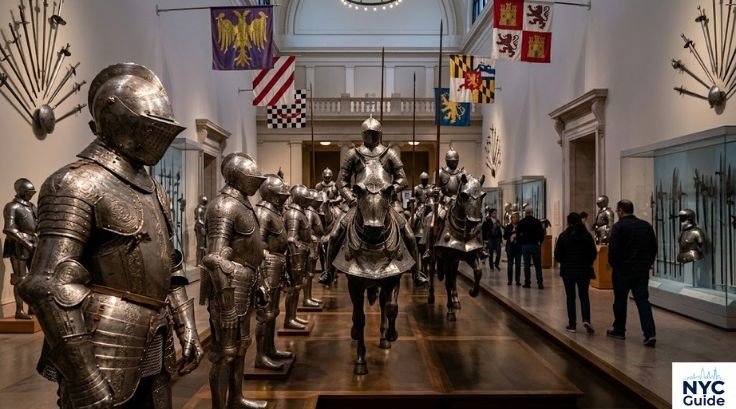
The Arms and Armor galleries contain one of the finest collections of medieval and Renaissance armor in the world. The equestrian armor displays are genuinely jaw-dropping. Children and adults alike tend to stop and stare. It is a section that many people underestimate before entering and cannot stop talking about afterward.
Astor Chinese Garden Court
This indoor courtyard is modeled after a Ming dynasty garden from sixteenth-century China. It was created by Chinese craftsmen using traditional materials and techniques. Walking into this space feels like stepping into another world entirely. It is one of the most peaceful corners of the entire museum.
The American Wing Courtyard
The glass-enclosed American Wing Courtyard houses sculptures, architectural fragments, and decorative objects from American history. The light inside the space is beautiful at almost any time of day. It is a wonderful place to sit quietly between gallery visits.
Best Met Museum Sections to Include in Your Guided Tour
Egyptian Art
The Egyptian Art department spans thirty-nine galleries and covers more than five thousand years of history. Highlights include the Temple of Dendur, the Tomb of Perneb, and one of the largest collections of Egyptian antiquities outside Cairo.
Greek and Roman Art
This section covers ancient Mediterranean cultures from the Cycladic period through the fall of the Roman Empire. The Greek and Roman galleries were renovated and reopened in 2007 to great acclaim. The space itself, with its vaulted ceilings and natural light, is as impressive as the objects inside.
European Paintings
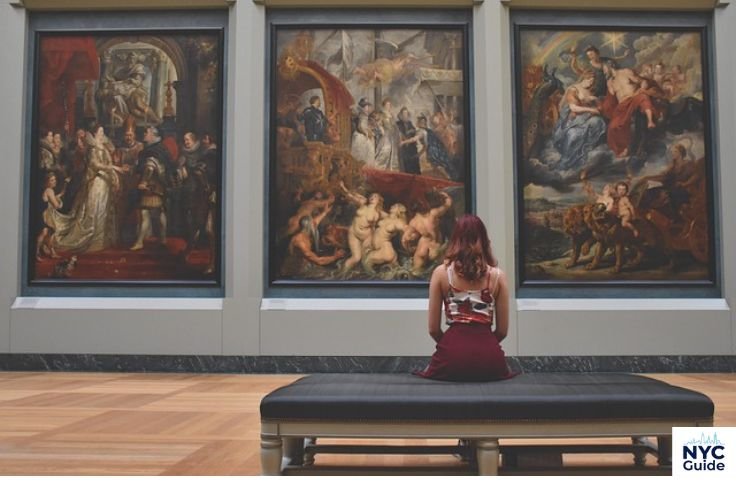
The European Paintings collection spans from the thirteenth to the nineteenth century and includes works by virtually every major artist of the period. This is one of the strongest collections of its kind in the Western Hemisphere.
Arms and Armor
The Arms and Armor galleries contain over fourteen thousand objects. The full equestrian armor display is unique among American museums. If you have children with you, plan to spend extra time here.
Medieval Art
The Medieval Art galleries cover the period from around 300 AD to 1600. The collection includes ivories, textiles, metalwork, enamels, and the famous collection of medieval stained glass. The Met Cloisters, located separately in upper Manhattan, is dedicated entirely to medieval art if you want to go even deeper.
Asian Art
The Asian Art galleries cover works from China, Japan, Korea, South and Southeast Asia, and the ancient Near East. The collection spans six thousand years and includes paintings, sculptures, ceramics, and decorative objects of extraordinary quality.
Islamic Art
The Islamic Art galleries were beautifully renovated and reopened in 2011. The collection covers fifteen centuries of art from across the Islamic world. The Moroccan Court and the Damascus Room are among the most stunning architectural installations in the museum.
Modern and Contemporary Art
The modern art collection begins with works from around 1900 and continues to the present day. Highlights include works by Picasso, Matisse, Pollock, and many others. The collection is housed across several floors and is continually growing.
American Decorative Arts
This section covers American furniture, silver, ceramics, and decorative objects from the seventeenth century onward. The period rooms, which recreate interiors from different eras of American history, are extraordinary in their detail and craftsmanship.
Famous Paintings to See at the Metropolitan Museum of Art
Pieter Bruegel the Elder, The Harvesters
Painted in 1565, this is one of only five surviving works from Bruegel’s cycle of the months. It shows peasants resting beneath a pear tree during the wheat harvest. The landscape stretches into the distance with remarkable naturalism for its era.
Johannes Vermeer, Allegory of the Catholic Faith
This is one of Vermeer’s more unusual works, filled with symbolic objects and religious meaning. It was painted around 1670 to 1672 and is one of only thirty-four or thirty-five paintings attributed to Vermeer in the entire world.
Diego Velázquez, Juan de Pareja
This portrait of Velázquez’s enslaved assistant was painted in 1650 as a warm-up exercise before the artist tackled a portrait of Pope Innocent X. It was displayed at the Pantheon in Rome and caused a sensation. The Met purchased it in 1971 for what was then a record price.
Jacques-Louis David, The Death of Socrates
Already described in the must-see artworks section, this painting is essential viewing for anyone interested in the relationship between art, politics, and philosophy.
Rosa Bonheur, The Horse Fair
Painted between 1852 and 1855, this enormous canvas depicts horses being led through the Paris horse market at the Boulevard de l’Hôpital. Bonheur dressed as a man to attend the market and make preparatory sketches. The energy and scale of the painting are extraordinary.
Claude Monet, The Four Trees
This late Monet work from 1891 shows four poplar trees reflected in still water. It is part of his famous Poplars series and demonstrates his evolving interest in light, color, and abstraction.
Vincent van Gogh, Cypresses
Already featured as a must-see, this painting rewards multiple visits. Each time you look, you notice new movement and intensity in the brushwork.
Pablo Picasso, Still Life with a Bottle of Rum
This 1911 Cubist work shows Picasso at the height of his analytical Cubism period. Objects dissolve into geometric fragments that overlap and intersect. It is a genuine milestone in the history of modern art.
Jackson Pollock, Autumn Rhythm (Number 30)
This 1950 masterwork is one of the defining images of Abstract Expressionism. At roughly seventeen feet wide, it is impossible to take in with a single glance.
Best Sculptures and Historical Objects to See at the Met
Hippopotamus “William”
This small blue faience hippopotamus from ancient Egypt is one of the most beloved objects in the entire museum. Made around 1961 to 1878 BC, it is decorated with lotus flowers and marsh plants. William, as he is affectionately known, has become the unofficial mascot of the Egyptian collection.
Seated Statue of Hatshepsut
Hatshepsut was one of ancient Egypt’s most powerful pharaohs. This seated statue, carved around 1479 to 1458 BC, shows her in a white linen dress wearing the double crown of Egypt. It is one of several Hatshepsut statues in the collection and is a masterpiece of ancient portraiture.
Lamassu
These massive winged bull sculptures with human heads once stood at the gates of an Assyrian palace around 900 to 700 BC. They were carved to ward off evil and communicate the power of the Assyrian kings. Standing beside one of these figures and considering its age is a genuinely humbling experience.
Shiva as Lord of Dance (Nataraja)
This bronze sculpture from South India, created around 1000 AD, shows the Hindu god Shiva performing the cosmic dance of creation and destruction. The four-armed figure stands within a ring of flames. It is one of the most recognizable works of South Asian art in the world.
Pendant Mask of Iyoba Idia
This sixteenth-century ivory mask from the Kingdom of Benin in present-day Nigeria is one of the most important works of African art in any Western collection. It depicts the queen mother Idia and was worn by the Oba of Benin during ceremonial occasions.
Mihrab
This magnificent prayer niche from a fourteenth-century mosque in Isfahan, Iran, is one of the finest examples of Islamic tilework in existence. The intricate geometric and calligraphic patterns are astonishing in their complexity and beauty.
Virgin and Child in Majesty
This Romanesque limestone sculpture from twelfth-century France shows the Virgin Mary seated on a throne holding the Christ child. It is both a devotional object and a landmark of medieval European sculpture.
Why Born Enslaved!
This marble sculpture was created by Jean-Baptiste Carpeaux in 1868. It shows a woman in chains, her head turned in anguish. The work confronts the brutal reality of slavery directly and is one of the most emotionally powerful sculptures in the American art section.
Hidden Gems Most Guided Tours Miss
Cubiculum from the Villa of P. Fannius Synistor at Boscoreale
This complete Roman bedroom was excavated from a villa near Pompeii that was buried by the eruption of Vesuvius in 79 AD. The frescoes that cover every wall are remarkably well preserved. Walking into this room feels like stepping directly into ancient Rome.
Studiolo from the Ducal Palace in Gubbio
This small study room was created for Federico da Montefeltro, Duke of Urbino, around 1478 to 1482. Every surface is covered in intricate wood inlay work that creates the illusion of open cabinets filled with objects. It is one of the finest examples of Italian Renaissance intarsia anywhere.
Patio from the Castle of Vélez Blanco
This early sixteenth-century marble courtyard was dismantled from a Spanish castle and reassembled at the Met in 1964. The carved marble columns and archways are extraordinary. Most visitors walk past without realizing they are standing inside a real piece of a Renaissance castle.
Rebbilib Navigation Chart
This navigational device was made by the Marshall Islanders of the Pacific to read ocean swell patterns for navigation between islands. It is made of thin sticks and shells. It looks like an abstract sculpture but is actually a sophisticated practical tool.
Frank Waller’s Interior View of the Metropolitan Museum of Art
This 1881 painting shows the interior of the original Met building before its massive expansion. It offers a fascinating glimpse into what the museum looked like in its early years. It hangs quietly in the American Wing and is passed by thousands of visitors every day.
One-Day Metropolitan Museum of Art Itinerary
Arrive at 10 AM when the doors open. Start with a ninety-minute guided highlights tour to orient yourself. After the tour, visit the Egyptian Art galleries independently and spend extra time with the Temple of Dendur. Have lunch at the museum restaurant or the outdoor cafe. In the afternoon, explore European Paintings at your own pace. Spend your last hour in the American Wing. Leave by 5 PM before the evening crowds arrive.
Two-Day Met Museum Itinerary for Art Enthusiasts
Day one follows the one-day itinerary above, with the addition of the Greek and Roman Art galleries in the late afternoon. Day two begins in Asian Art and the Astor Chinese Garden Court. Move through Islamic Art and then Medieval Art. After lunch, dedicate the afternoon entirely to Modern and Contemporary Art. Finish with a visit to the rooftop garden if the season allows. Two days allow you to see the major departments without rushing.
Metropolitan Museum of Art Guided Tour for Families
Family tours at the Met are designed to be active and engaging. The museum offers Art Trek tours for families with children ages six and up. Guides use storytelling, questions, and hands-on observation techniques to keep children involved.
The best family route combines Egyptian Art, Arms and Armor, and the American Wing. These three sections consistently generate the most excitement among children. Plan breaks every hour and build in time for snacks. The museum has a family-friendly cafe on the ground floor.
Metropolitan Museum of Art Guided Tour for Kids
Children under twelve enter free with an accompanying adult. The Met offers dedicated family programs including sketch sessions, gallery games, and themed tours during school holidays.
The most child-friendly sections are Egyptian Art, Arms and Armor, and the musical instruments gallery. The mummies and warrior armor spark immediate interest in even reluctant young visitors. The Met’s website lists current family programming, which changes by season.
Accessible Guided Tours at the Met
The Met is committed to making its collection accessible to all visitors. The museum offers tours specifically designed for visitors with visual impairments, using detailed verbal description and touchable reproduction objects. Tours for visitors with hearing impairments are available in American Sign Language.
The museum is fully wheelchair accessible, with elevators serving all floors. Audio guides are available with captioning options. Visitors with cognitive disabilities can access social narratives and sensory-friendly visit guides through the museum’s website.
If you have specific accessibility needs, contact the museum in advance and they will help plan the best experience for your visit.
Metropolitan Museum of Art Audio Guide and Mobile App
The Met’s official audio guide covers more than five hundred works across all major galleries. It is available as a rental device at the museum entrance for around $7, or as a free download through the MetCollections app on iOS and Android.
The app includes maps, audio commentary, and the ability to save and share favorites. It works offline once downloaded, which is helpful if you want to avoid using mobile data inside the building. The app is regularly updated and is genuinely one of the better museum apps available.
Visitor Rules and Museum Etiquette
The Met expects visitors to treat both the artworks and other visitors with respect. Do not touch any artwork, sculpture, or displayed object unless explicitly invited to do so during a specialized program. Maintain a reasonable noise level in all galleries.
Food and drinks are not permitted in gallery spaces. Large backpacks must be carried in front of the body or checked at the coat check. Strollers are welcome but must remain folded in certain smaller galleries.
If you are visiting with children, remind them before entering that the artworks are very old and very fragile. Most children respond well to this framing.
Photography Rules Inside the Met
Personal photography is permitted throughout most of the Met’s permanent collection galleries. You may use your smartphone or camera freely in most spaces. Flash photography is not permitted anywhere in the museum as it can cause long-term damage to pigments and materials.
Tripods and selfie sticks are not allowed. Commercial photography and video production require prior written permission from the museum. Some temporary exhibitions have additional restrictions which are posted at the gallery entrance.
What to Wear and Bring for a Met Guided Tour
Wear comfortable shoes. You will walk several miles during a full visit and the floors are hard marble throughout. Comfortable, supportive footwear makes an enormous difference.
Dress in layers. The museum can feel cool in heavily air-conditioned summer months and warm during winter. A light sweater or jacket is useful year-round.
Bring a refillable water bottle. Water fountains are available throughout the museum. Carry a small notebook if you like to jot down names of works you want to research later. Your phone is essential for the app and for photography.
Leave large bags at home if possible. The coat check is available but adds time to your entry process.
Best Nearby Attractions After Visiting the Met
Central Park
The museum sits directly on the eastern edge of Central Park at 82nd Street. After your visit, a walk into the park is the obvious and deeply pleasant choice. The nearby Turtle Pond and Belvedere Castle are worth exploring. In warm weather, the park is an ideal place to decompress after hours of museum-going.

Fifth Avenue
The section of Fifth Avenue running along the eastern edge of Central Park is lined with some of New York’s most famous addresses. A short walk south takes you through the heart of Manhattan’s luxury shopping district. Even if shopping is not your priority, the architecture and street energy are worth experiencing.
Solomon R. Guggenheim Museum
The Guggenheim is a fifteen-minute walk north of the Met at 89th Street. Frank Lloyd Wright’s spiral building is an architectural landmark in its own right. The permanent collection focuses on modern and contemporary art and complements a Met visit beautifully.
The Frick Collection
The Frick is located at 70th Street, about a fifteen-minute walk south of the Met. It houses a spectacular private collection of European paintings, decorative arts, and sculpture in a mansion setting. It is one of the finest small museums in the United States and pairs wonderfully with a Met visit.
Museum Mile
The stretch of Fifth Avenue between 82nd and 105th Streets is home to nine major cultural institutions, including the Met, the Guggenheim, the Jewish Museum, and El Museo del Barrio. Museum Mile is listed on the National Register of Historic Places and is a destination in itself.
Best Restaurants Near the Metropolitan Museum of Art
The Met has multiple dining options inside the building, including the American Wing Cafe, the Petrie Court Cafe, and the Dining Room on the ground floor. Prices are moderate and the quality is reasonable for a museum setting.
Outside the museum, the Upper East Side neighborhood offers excellent dining options at every price point. Eli’s Table on Third Avenue is a popular choice for a relaxed lunch. Caravaggio on East 74th Street is a classic Italian restaurant favored by locals. For a more casual option, the numerous cafes along Madison Avenue are ideal for a quick bite between museum stops.
Best Hotels Near the Metropolitan Museum of Art
The Upper East Side has excellent hotel options close to the Met. The Carlyle at 76th Street and Madison Avenue is one of New York’s most storied luxury hotels and is a short walk from the museum. The Mark Hotel at 77th Street is another top-tier option with a beautiful design aesthetic.
For mid-range travelers, the Hotel Wales on Carnegie Hill and the Franklin Hotel on East 87th Street offer comfortable accommodation within easy walking distance. Staying on the Upper East Side allows you to arrive at the museum at opening time without the stress of a long commute.
Frequently Asked Questions About Metropolitan Museum of Art Guided Tours
Some private tour operators offer timed entry or priority access arrangements that reduce waiting. The Met does not have a traditional skip-the-line system for general admission. Arriving early in the morning is the most reliable way to avoid queues.
The Temple of Dendur, Washington Crossing the Delaware, Madame X, Autumn Rhythm by Pollock, and the Van Gogh Cypresses are among the most celebrated works in the collection. The Arms and Armor galleries and the Astor Chinese Garden Court are also not to be missed.
The highlights tour is the best choice for first-time visitors. It provides a broad overview of the collection across multiple departments and gives you a strong foundation for further independent exploration.
You can cover the major highlights in one full day, but you cannot see everything. A realistic one-day visit allows you to experience four to six major departments comfortably. Starting early and focusing on a planned route makes the most of limited time.
Yes, absolutely. The Met is so large and its collection so vast that a guide transforms the experience. You will understand more, remember more, and feel far less overwhelmed. Even if you have visited before, a guided tour often reveals details and stories you have never noticed.
Yes. The Met offers family-focused Art Trek tours and various seasonal programs designed specifically for children. These tours use storytelling and interactive approaches to keep younger visitors engaged throughout.
Personal photography is permitted in most permanent collection galleries. Flash photography is never allowed. Tripods and selfie sticks are prohibited. Some temporary exhibitions have additional restrictions posted at the entrance.
Final Thoughts
A Metropolitan Museum of Art guided tour is one of the great cultural experiences available anywhere in the world. Whether you choose a highlights tour, a private VIP experience, or a self-guided exploration with the audio app, the Met rewards every approach.
The key is to arrive with a plan, dress comfortably, and resist the temptation to see everything in a single visit. The museum is best experienced slowly, with attention and curiosity.
I have visited the Met more times than I can count and it never feels the same twice. There is always something I have not noticed before, always a painting that catches me off guard, always a corner of history I had forgotten existed. That is the real gift of this extraordinary place.