
Planning a trip to New York City and wondering if High Line Park is worth your time? You’re not alone. Many visitors feel overwhelmed by the sheer number of things to do in NYC and aren’t sure where to start. The High Line is one of those rare places that genuinely lives up to the hype.
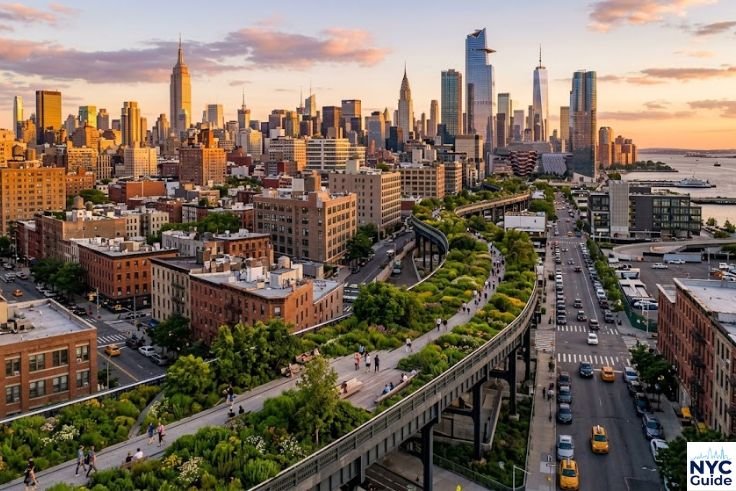
High Line Park is one of the most unique outdoor experiences in the entire city. It sits above the streets of Manhattan, offering stunning views, beautiful greenery, and world-class art all for free. Whether you’re a first-time visitor or a returning traveler, this guide will help you plan your walk confidently.
In this complete guide, I’ll cover everything you need to know. From the history of this elevated park in New York City to the best viewpoints, nearby attractions, and practical visitor tips you’ll find it all here. Let’s get started.
What Is the High Line Park?
The High Line is a public elevated park built on a historic freight railway line in Manhattan. It stretches 1.45 miles along the west side of Manhattan, running from Gansevoort Street in the Meatpacking District up to 34th Street near Hudson Yards. The park sits roughly 30 feet above street level, giving visitors a completely different perspective of the city.
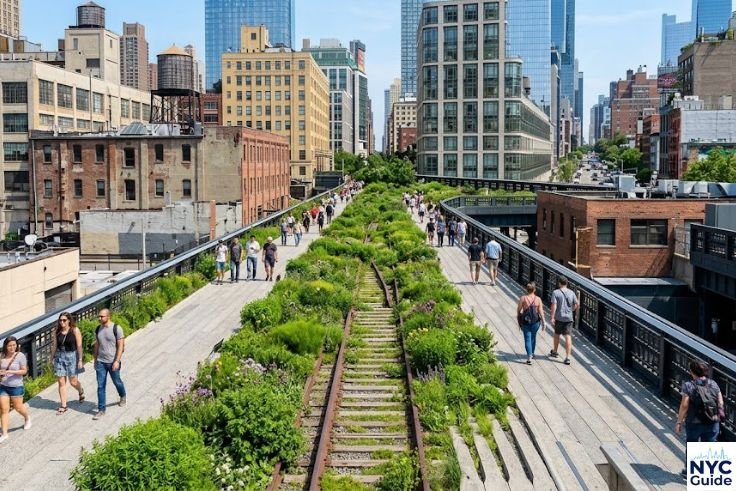
What makes it truly special is the concept behind it a “park in the sky.” Instead of tearing down an old, rusted rail structure, New York City transformed it into a beautifully designed urban greenway. Today it features walking paths, planted gardens, seating areas, art installations, and sweeping views of both the Hudson River and the Manhattan skyline.
The park is managed by Friends of the High Line, a nonprofit organization that works with the NYC Department of Parks and Recreation. It welcomes millions of visitors every year and has become one of the most celebrated examples of adaptive reuse architecture in the world.
History of the High Line
Industrial Railway Origins
The High Line was originally built in the 1930s as an elevated freight railway. Before that, trains used to run along 10th Avenue at street level, which was so dangerous that the stretch became known as “Death Avenue.” Horses carrying warning flags would ride ahead of the trains to alert pedestrians yet accidents still happened frequently.
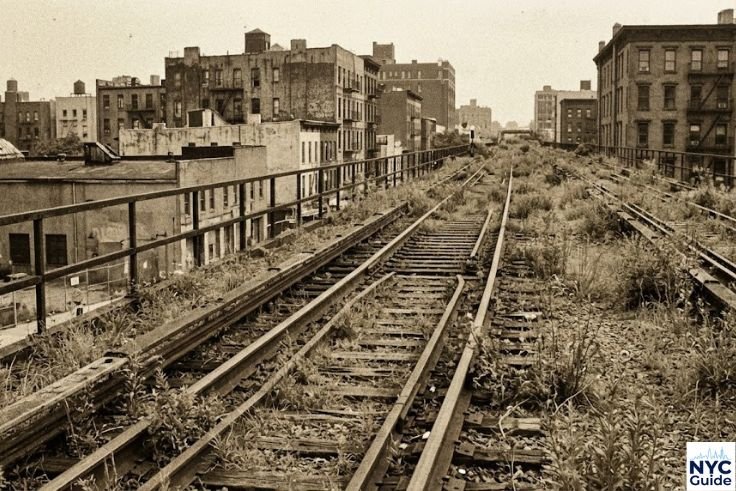
To solve this, the city built the elevated rail line specifically to move goods off the street and into the upper floors of factories and warehouses directly. This was a major infrastructure project that connected the meatpacking, dairy, and food distribution industries along Manhattan’s west side.
Decline and Abandonment
By the 1950s and 1960s, the trucking industry began replacing rail freight across America. The southern portion of the High Line was demolished in 1960. By 1980, the last train carrying a load of frozen turkeys ran along the tracks. After that, the structure sat unused and slowly began to deteriorate.
For nearly two decades, the abandoned railway became covered in wild grasses, flowers, and self-seeded plants. Some property owners wanted the structure torn down entirely. It looked like demolition was almost certain.
The Vision and Transformation into a Park
In 1999, two neighborhood residents named Joshua David and Robert Hammond founded the Friends of the High Line. They had a bold vision instead of tearing down the structure, why not transform it into a public park? Their idea was initially met with skepticism, but they kept pushing.
After years of community advocacy, planning, and fundraising, the first section of the High Line opened to the public in June 2009. The second section opened in 2011, and the final section known as the Rail Yards opened in 2014. Today, this former abandoned railway turned park stands as one of the greatest urban redevelopment success stories in modern history.
High Line Entrances and Access Points
The High Line has multiple entry points along its length, so you can start or end your walk from several different locations. Here are the main access points:
Gansevoort Street (Southern End) — This is the main entrance and the most popular starting point. It’s located in the Meatpacking District and is steps away from the Whitney Museum of American Art.
14th Street — A convenient access point if you’re coming from the subway or exploring the Chelsea neighborhood.
16th Street — Another mid-section entry point, useful if you’re coming from Chelsea Market nearby.
18th Street — Good for accessing the middle section of the park, close to several art galleries.
20th Street — One of the quieter entry points, useful if you want to avoid the busier southern end.
23rd Street — A central access point with easy subway connections. This is a great spot to start if you’re coming from Midtown.
26th Street — Near the Viewing Spur, a popular photo spot.
28th Street — Leads you into the northern section close to the Rail Yards.
30th Street (Rail Yards End) — The northern entry point near Hudson Yards.
34th Street (Far Northern End) — The newest extension connects near the Javits Center and Hudson Yards.
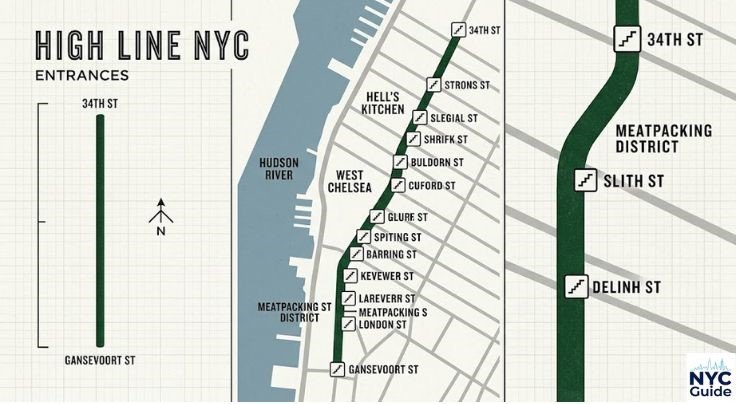
Elevator access is available at several locations including Gansevoort Street, 14th Street, 16th Street, 23rd Street, 30th Street, and 34th Street. The High Line is fully accessible for visitors using wheelchairs or strollers. Ramps are also available at many entry points. If mobility is a concern, I’d recommend starting at 23rd Street or Gansevoort, as those have the smoothest elevator and ramp access.
Walking the High Line: What to See Along the Way
This is the heart of the visit. Walking the High Line is a sensory experience you’ll move through gardens, sit in the sun, watch the city below, and encounter art you didn’t expect. Here’s what you’ll find along the route from north to south.
Rail Yards (30th Street Section)
The Rail Yards section sits at the northern end and offers some of the most open, airy stretches of the entire park. This area feels more raw and spacious compared to the busier southern sections. You can see remnants of the original railway tracks embedded into the walkway, which gives this stretch a strong sense of industrial heritage. On clear days, the Hudson River views from here are absolutely stunning. I remember standing here on a crisp autumn morning and just staring at the water it felt miles away from the chaos of Manhattan below.
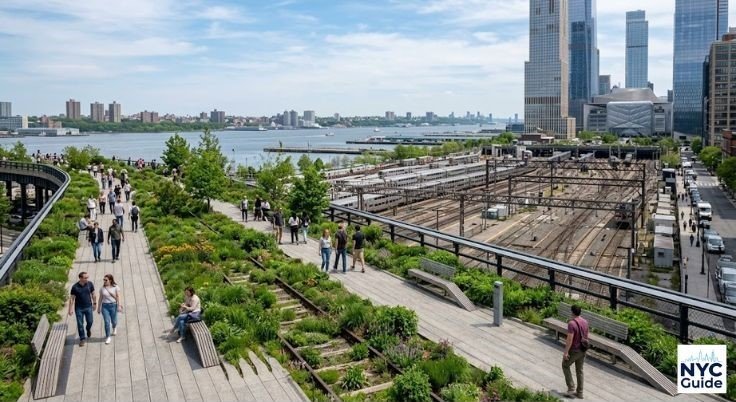
26th Street Viewing Spur
This is one of the most photographed spots on the entire High Line. The Viewing Spur extends out from the main path like a narrow platform over 10th Avenue. Looking down, you can see the stream of taxis, cyclists, and pedestrians flowing through the city. Looking up, you get a dramatic frame of the Manhattan skyline. It’s a great spot for photography and takes just a few minutes to enjoy. Don’t skip it.
Woodland Flyover
The Woodland Flyover is a slightly elevated walkway within the park that takes you through a dense canopy of trees. It feels surprisingly secluded for a place in the middle of Manhattan. The path is narrow and wooden, and the trees on either side create a natural tunnel effect. This is one of those spots where you genuinely forget you’re in New York City for a moment. It’s especially beautiful in spring when everything is in bloom.
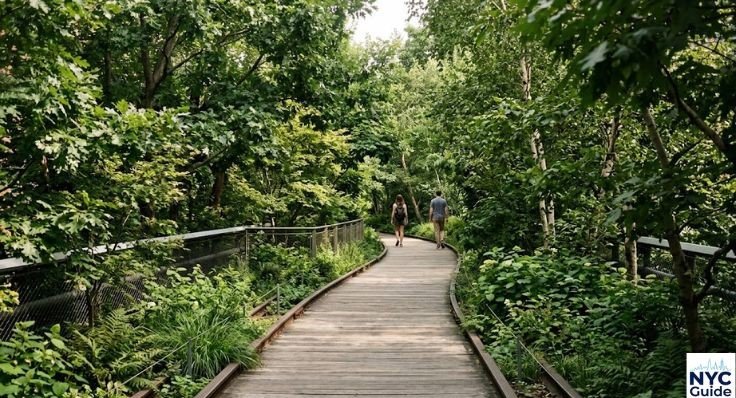
22nd Street Seating and 23rd Street Lawn
The 23rd Street Lawn is a favorite resting spot for both locals and tourists. There’s a stretch of real grass where people spread out, sit, read, or just take a break. The seating areas around 22nd Street are thoughtfully designed some benches are built directly into the rail structure. This is a great place to pause, eat a snack, and watch the city life happening below.
10th Avenue Square and Overlook
The 10th Avenue Square is one of the most social spaces on the High Line. It features tiered seating that faces a large window overlooking 10th Avenue below. Watching cars and pedestrians from this elevated vantage point feels almost theatrical. During warmer months, this area gets lively with crowds. In my experience, visiting on a weekday morning made this spot far more enjoyable and less crowded.
Chelsea Market Passage
As you pass over the Chelsea Market Passage section, you’ll notice the landscape design becomes more intimate and lush. The plantings here are particularly dense and wild-looking, designed to mimic the natural vegetation that grew on the abandoned tracks. This area connects visually and physically to one of NYC’s most beloved food markets just below Chelsea Market. If you’re hungry, this is a good reminder to stop and grab something to eat when you come back down.
Diller–von Furstenberg Sundeck and Water Feature
This section features a beautiful sundeck with a shallow water feature that stretches along the path. During summer, it becomes one of the liveliest spots on the High Line. Children splash in the water, visitors lounge on wooden deck chairs, and the whole area feels like an urban beach. The sundeck was a gift from designer Diane von Furstenberg and her husband Barry Diller. It’s located near 14th Street and is perfect for a warm afternoon visit.
Gansevoort Woodland
The Gansevoort Woodland marks the southern tip of the High Line near the main entrance. It features a dense planting of trees and shrubs that provide shade and a sense of privacy. This section is quieter than the rest of the park and has a slightly more contemplative feel. It’s a lovely place to begin or end your walk. From here, you’re just steps from the Whitney Museum and the Meatpacking District.
Art and Design on the High Line
The High Line isn’t just a park it’s an outdoor art gallery. Throughout the year, Friends of the High Line commissions public art installations that are displayed along the walking path. These range from large-scale sculptures to photography exhibits, murals, and performance art.
Some installations are permanent, while others rotate seasonally. Past works have included pieces by internationally recognized artists. The art is integrated into the landscape rather than just placed on top of it, which makes the experience feel cohesive and intentional.
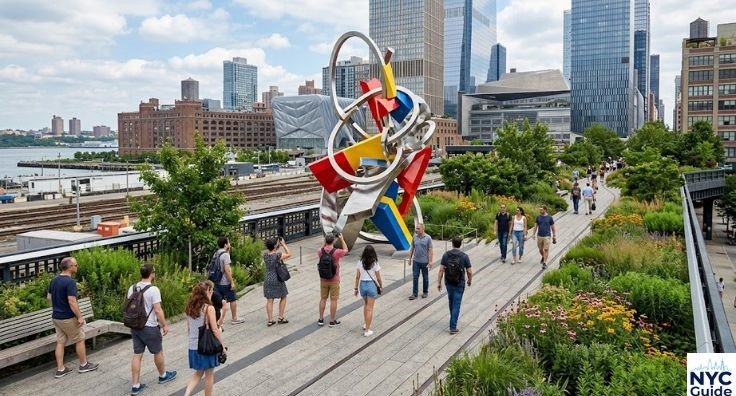
The landscape design itself is a work of art. Designed by James Corner Field Operations in collaboration with Diller Scofidio + Renfro and planting designer Piet Oudolf, the High Line uses a mix of grasses, perennials, shrubs, and trees that change with the seasons. Spring brings blooms, summer is lush and green, autumn turns golden, and even winter has a certain stark beauty.
The architecture of the surrounding buildings also adds to the visual experience. You’ll see a mix of old industrial warehouses, modern glass towers, and creative adaptive reuse buildings as you walk. Hudson Yards, visible from the northern section, is a striking example of contemporary architecture rising right next to this historic greenway.
How Long Does It Take to Walk the High Line?
The High Line is approximately 1.45 miles long from end to end. If you walk straight through without stopping, it takes roughly 30 minutes. However, most visitors spend between 1 and 2 hours depending on how often they stop to enjoy views, take photos, or sit down.
If you’re the type who likes to linger at art installations, read the plant labels, or just sit and people-watch, budget around 2 hours. If you’re visiting with children, add extra time for the water feature at the sundeck and the lawn areas.
Suggested walking routes:
For a quick visit (45 minutes): Start at 23rd Street, walk south to Gansevoort, and exit near the Whitney Museum.
For a full experience (1.5 to 2 hours): Start at 34th Street or 30th Street, walk the full length south to Gansevoort. This gives you the complete High Line walking route from north to south.
For a relaxed half-day: Walk the full route, stop for breaks, grab food at Chelsea Market when you come down, and visit a nearby gallery or the Whitney Museum afterward.
Getting to the High Line
By Subway:
The High Line is easily reachable by several subway lines.
For the southern entrance at Gansevoort Street: Take the A, C, or E train to 14th Street or the L train to 8th Avenue.
For the 23rd Street entrance: Take the C or E train to 23rd Street.
For the northern end near 34th Street: Take the A, C, or E train to 34th Street–Penn Station or the 7 train to Hudson Yards.
By Bus:
The M11 bus runs along 9th and 10th Avenues and stops near multiple High Line entrances. The M14 crosstown bus also connects to the 14th Street entrance area.
Nearby Neighborhoods:
Chelsea is directly alongside the High Line from 14th Street to 30th Street. It’s filled with art galleries, restaurants, and cafés.
The Meatpacking District sits at the southern end. It’s one of NYC’s trendiest neighborhoods with great nightlife, boutiques, and restaurants.
Hudson Yards is at the northern end and features modern shopping, dining, and attractions like The Edge observation deck and the Vessel sculpture.
Can You Take a Tour of the High Line?
Yes, guided tours are available. Friends of the High Line offers free public tours on select days and times throughout the year. These tours are led by trained volunteer guides who share the history, horticulture, and design stories behind the park. Check the official High Line website for the current tour schedule before you visit.
If you prefer a self-guided experience, the High Line app and website provide detailed audio guides and maps. Walking it on your own gives you total flexibility to move at your own pace, which is honestly how I prefer to experience it.
Best time to visit:
Early morning on weekdays is the best time to visit if you want a quieter, more peaceful experience. The park opens at 7:00 AM, and the first hour or two are noticeably less crowded. Late spring and early fall offer the most comfortable weather and the best plant displays. Summer weekends can be extremely busy manageable, but crowded.
Facilities at the High Line
Are There Bathrooms?
Yes. Public restrooms are available at multiple points along the High Line including near the Gansevoort entrance, the 16th Street entrance, the 23rd Street area, and the 30th Street section. They are clean, accessible, and free to use.
Seating Areas and Rest Zones
There are plentiful seating options throughout the park. Built-in wooden benches, movable chairs, lawn areas, and the tiered seating at 10th Avenue Square all offer places to rest. The 23rd Street Lawn is a favorite for longer breaks.
Food and Drink Options
There are food vendors and small kiosks located at several points along the High Line, particularly during warmer months. You’ll find coffee, snacks, ice cream, and light bites available. For a full meal, the best option is to descend to Chelsea Market, which is just a short walk from the 16th Street entrance and offers a wide range of food options inside a historic building.
Things to Do Near the High Line
One of the great things about visiting the High Line is that it drops you right in the middle of some of Manhattan’s most interesting neighborhoods. Here’s what’s worth seeing nearby.
Chelsea Market — Located at 75 9th Avenue, Chelsea Market is a food hall and shopping destination inside a converted factory building. It’s filled with restaurants, bakeries, specialty food shops, and retail stores. This is the perfect post-walk stop for lunch or a coffee. The architecture alone is worth a look.
Hudson Yards — The northern end of the High Line connects directly to Hudson Yards, NYC’s newest neighborhood. It features upscale shopping at The Shops at Hudson Yards, the Thomas Heatherwick-designed Vessel (a climbable honeycomb sculpture), and several top-rated restaurants.
The Edge — Located at Hudson Yards, The Edge is the highest outdoor sky deck in the Western Hemisphere. It sits 100 floors above street level and features a glass floor and angled glass walls. If you don’t have a fear of heights, it’s an unforgettable experience. Tickets are required and should be booked in advance.
Whitney Museum of American Art — Sitting right at the southern foot of the High Line near Gansevoort Street, the Whitney Museum is one of America’s premier art museums. It focuses on 20th and 21st century American art and has an excellent permanent collection alongside rotating exhibitions. The building itself, designed by Renzo Piano, is architecturally striking. Admission is required but it’s well worth it for art lovers.
Tips for Visiting the High Line
Best time to visit: Go on a weekday morning, ideally between 7:00 AM and 10:00 AM. The park opens at 7:00 AM and is far quieter in the early hours. Late spring (April–June) and early fall (September–October) offer the best weather and plant displays.
Avoiding crowds: If you visit on a weekend afternoon in summer, expect significant crowds especially at the Gansevoort entrance, 10th Avenue Square, and the Sundeck. Starting from the northern end (30th or 34th Street) on busy days means you’ll face lighter crowds at first and gradually move into busier areas.
Photography tips: The best light for photography is in the early morning when the sun hits the Hudson side of the park. The 26th Street Viewing Spur is the top photo spot. For architectural shots, the sections near Hudson Yards and the Rail Yards offer dramatic city backdrops. Bring a wide-angle lens if you have one the park’s linear shape rewards it.
Wear comfortable shoes: The walking surface is smooth but you’ll be on your feet for a while. Comfortable shoes are a must.
Bring water: Especially in summer. There are water fountains available along the route but bringing your own bottle is always a smart idea.
Download the app: The official High Line app has a map and audio guide that can really enrich your visit, especially if you’re interested in the art and landscape design details.
High Line NYC FAQs
Art installations are displayed throughout the entire length of the park. You’ll encounter sculptures, photography, and other works integrated into the landscape as you walk. Rotating seasonal exhibits are announced on the official High Line website. The section between 18th and 23rd Streets tends to have a particularly strong concentration of art.
Yes, admission to the High Line is completely free. The park is open to the public at no cost year-round. Some special events or programming may have a fee, but simply walking and enjoying the park costs nothing.
The High Line is open daily from 7:00 AM to 10:00 PM most of the year. Hours may vary slightly by season during winter months the park typically closes earlier. It’s always a good idea to check the official High Line website for updated hours before your visit.
Absolutely. In my experience visiting New York City multiple times, the High Line consistently ranks among the most memorable experiences the city offers. It’s free, it’s beautiful, it’s unique, and it connects you to some of the city’s best neighborhoods. Whether you have 45 minutes or half a day, a walk on the High Line is always time well spent.
Final Thoughts
The High Line Park is more than just a scenic walk it’s a living example of what’s possible when a city decides to protect and reimagine its past. From the ghost of old railway tracks embedded in the path to the world-class art installations overhead, every section of this elevated park tells a story.
If you’re visiting New York City, make time for the High Line. Start early, wear comfortable shoes, and let yourself slow down. Grab a coffee from a vendor, sit on the lawn, look out over the Hudson, and just take it all in. You’ll understand why so many people consider it one of the best things to do in New York City.
And when you’re done, you’re already in the perfect spot to explore Chelsea, grab lunch at Chelsea Market, or head up to Hudson Yards for The Edge. The High Line doesn’t just offer a great walk it opens the door to some of the best of Manhattan’s west side.