
If you’ve ever looked at photos of New York Harbor and wondered about the story behind that towering green figure, you’re not alone. Most people know the Statue of Liberty as a symbol of America, but very few know the full picture the history, the hidden meanings, and the surprising secrets buried in every detail. These statue of Liberty facts go far deeper than what you’ll find on a postcard.
I’ve spent years researching iconic landmarks, and the Statue of Liberty never stops surprising me. From its French origins to its role as an actual lighthouse, this monument has layers that most visitors never discover. This guide is here to change that.
Whether you’re planning a visit to Liberty Island or just curious about one of the world’s most recognized structures, this article covers everything. You’ll leave with a completely new understanding of Lady Liberty and why she still matters today.
Why Was the Statue of Liberty Built?
The Statue of Liberty was built to celebrate the friendship between France and the United States and to honor the ideals of freedom and democracy. French political thinker Édouard de Laboulaye proposed the idea around 1865, inspired by the end of the American Civil War and the abolition of slavery. He wanted to create a monument that symbolized shared democratic values between the two nations.
The timing was also political. France was living under the authoritarian rule of Napoleon III, and many French republicans admired America’s experiment in democracy. The statue was meant to be a reminder for both countries of what freedom could look like.
The Story Behind the Statue of Liberty
The story of the Statue of Liberty is one of international cooperation, creative vision, and remarkable engineering. It began as an idea over dinner in France and ended up becoming one of the most recognized structures on earth.
Who Designed the Statue of Liberty?
French sculptor Frédéric Auguste Bartholdi designed the statue. He visited the United States in 1871 to scout locations and immediately fell in love with Bedloe’s Island in New York Harbor, which later became Liberty Island. Bartholdi spent years refining his design before construction began.
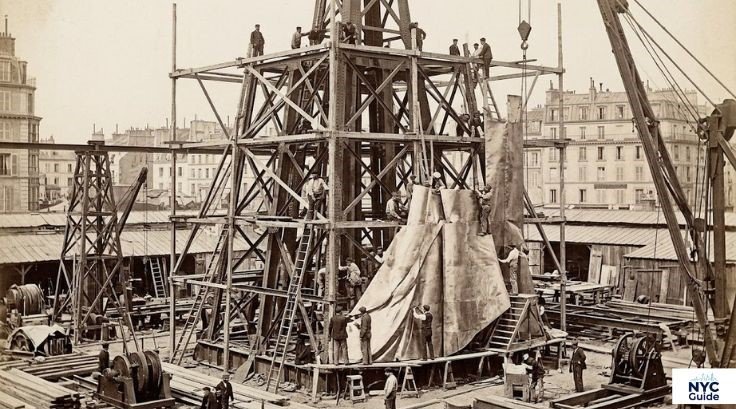
The internal iron framework that holds the statue upright was engineered by Gustave Eiffel yes, the same man who later built the Eiffel Tower. His revolutionary design allowed the copper skin to flex slightly in the wind without cracking, which was a genuine engineering breakthrough at the time.
Who Was the Statue Originally Built For?
This is where it gets interesting. Bartholdi originally sketched ideas for a monumental statue for the entrance of the Suez Canal in Egypt. That project never moved forward. When the American project took shape, some historians believe Bartholdi adapted his earlier ideas. The figure was always intended to represent a robed woman holding a torch a universal symbol of enlightenment.
Why Was It Gifted to the United States?
France gifted the statue to the United States as a gesture of friendship and shared ideals. The French people funded the statue itself, while Americans were responsible for funding and building the pedestal. The gift was also a celebration of the centennial of American independence, though construction delays pushed the dedication to 1886.
The Symbolism of Lady Liberty
Every inch of the Statue of Liberty was designed with intention. Nothing is accidental. Understanding the symbolism completely changes how you look at her.
Why Is She Called Lady Liberty?
The statue’s official name is “Liberty Enlightening the World” in French, La Liberté éclairant le monde. She’s called Lady Liberty because she personifies the concept of freedom as a female figure, following a long tradition in Western art of representing abstract ideals as women. Think of figures like Marianne in France or Britannia in the UK.
Who Is Lady Liberty Based On?
There’s no single confirmed inspiration for her face. Bartholdi reportedly modeled her face after his mother, Charlotte Beysser Bartholdi, though this has never been definitively proven. Some art historians suggest the face resembles classical Greco-Roman goddesses. Her body is modeled on the neoclassical style common in French sculpture of that era.
Lady Liberty’s Motto
The motto associated with Lady Liberty is deeply tied to the poem engraved on her pedestal: “Give me your tired, your poor, your huddled masses yearning to breathe free.” This line comes from Emma Lazarus’s sonnet The New Colossus, written in 1883. It transformed the statue’s meaning from a political symbol between two nations into a universal beacon for immigrants seeking a new life.
What the Crown Represents
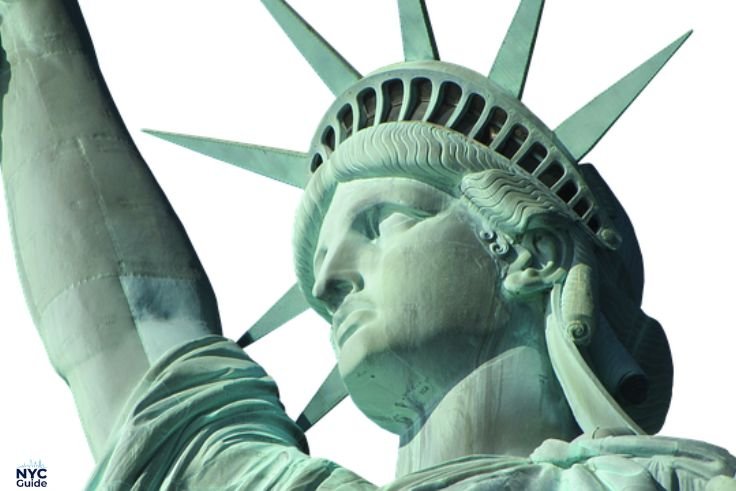
The crown on Lady Liberty’s head has seven spikes. Those spikes represent the seven seas and seven continents of the world, radiating the light of liberty outward in all directions. Each spike is about nine feet long and weighs around 150 pounds. Standing inside the crown and looking out through the small windows is one of the most memorable experiences you can have at the monument.
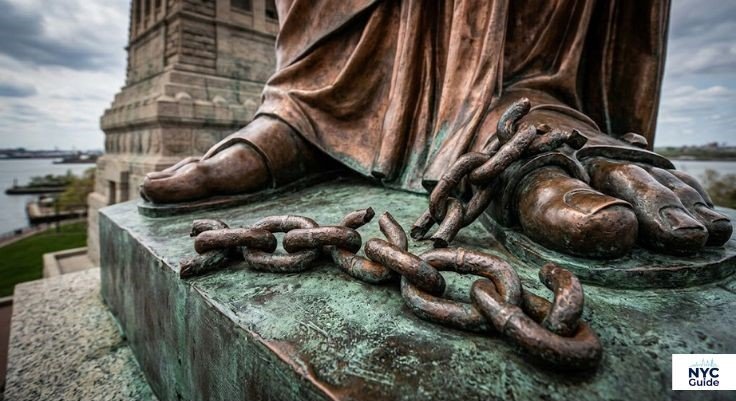
Chains at Her Feet
Most people never notice what’s at Lady Liberty’s feet because you can’t see it from a distance. She is standing on a broken chain and shackles. This was a direct reference to the abolition of slavery in the United States. Bartholdi and Laboulaye wanted the statue to represent freedom not just in the abstract, but specifically freedom from oppression and bondage. It’s one of the most powerful details on the entire monument.
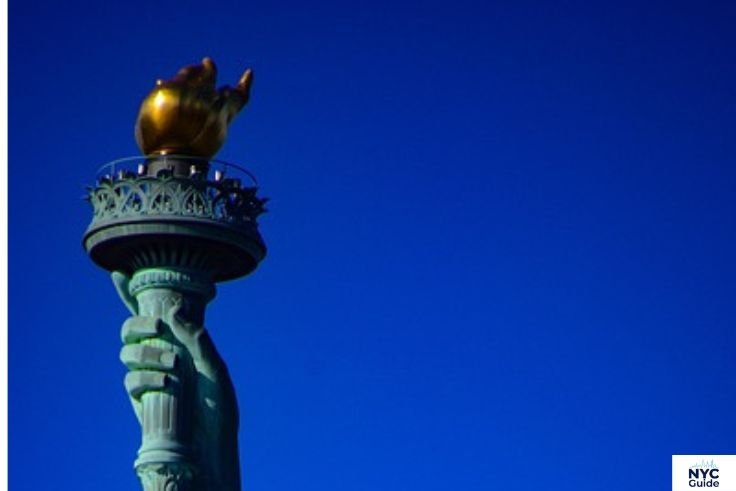
What the Torch Symbolizes
The torch Lady Liberty holds high in her right hand represents enlightenment. The idea is that she is literally lighting the way for the world guiding people toward freedom and knowledge. The original torch was replaced in 1986 with a new version covered in 24-karat gold leaf, which reflects sunlight by day and is illuminated by floodlights at night.
What the Tablet Represents
Lady Liberty holds a tablet in her left hand inscribed with the date July 4, 1776 American Independence Day in Roman numerals: JULY IV MDCCLXXVI. The tablet represents the rule of law and the foundation of American democracy. The combination of the torch (enlightenment) and the tablet (law) together form the core message of the statue: freedom guided by justice.
Statue of Liberty Facts You May Not Know
These are the details that don’t make it into the brochures. I find these the most fascinating parts of the whole story.
The Original Model May Have Been an Egyptian Woman
Before the American project took shape, Bartholdi had proposed a colossal statue of a robed woman for the entrance to the Suez Canal in Egypt. The figure was described as representing “Egypt carrying the light to Asia.” That project was rejected on budget grounds. When Bartholdi pivoted to the American concept, scholars believe he reused elements of that design. The similarities in the robed female form are hard to ignore.
The Statue Was Intended to Celebrate Abolition
Édouard de Laboulaye was a passionate opponent of slavery and a great admirer of Abraham Lincoln. The original idea for the statue was directly tied to the end of the Civil War and the abolition of slavery. Laboulaye saw America’s emancipation of enslaved people as proof that democracy could triumph over injustice. The broken chains at the statue’s feet were not an afterthought they were central to the original vision.
The Pedestal Was Funded Through Crowdfunding
The American committee responsible for building the pedestal ran out of money by the mid-1880s. Publisher Joseph Pulitzer used his newspaper, The New York World, to run a fundraising campaign. He promised to print the name of every single donor, no matter how small the contribution. Over 120,000 people donated, many giving less than a dollar. It was essentially the first major crowdfunding campaign in American history.
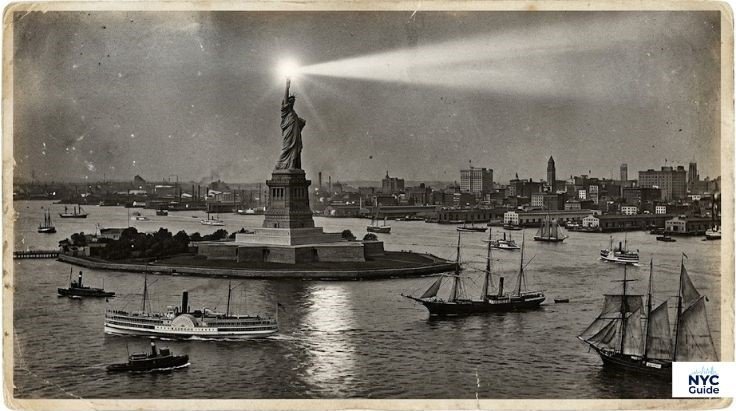
The Statue Once Served as a Lighthouse
From 1886 to 1902, the Statue of Liberty actually functioned as an official lighthouse. The torch was visible from 24 miles out to sea. The U.S. Lighthouse Board operated it during this period. However, the light proved too weak to be practically useful for navigation, and the lighthouse function was eventually discontinued.
Visitors Can No Longer Enter the Torch
The torch has been closed to visitors since 1916. On July 30, 1916, German agents sabotaged a nearby munitions depot on Black Tom Island in New Jersey. The resulting explosion damaged the statue’s arm and torch. Repairs were made, but the narrow staircase inside the arm just 40 inches wide was deemed too dangerous for public access and has remained closed ever since.
The Statue Sways in Strong Winds
Gustave Eiffel’s design deliberately allows the statue to move. In winds of 50 miles per hour, the statue can sway up to three inches. The torch arm swings up to five inches. This flexibility is actually what keeps the structure intact during storms a rigid design would crack under the same conditions. It’s a brilliant piece of engineering that’s still admired by structural engineers today.
Lightning Frequently Strikes the Statue
The Statue of Liberty is struck by lightning approximately 600 times per year. This is not surprising given its height and copper construction. Copper is an excellent conductor, so the statue essentially acts as a giant lightning rod over New York Harbor. The grounding system built into the structure handles each strike safely.
Her Head and Arm Are Slightly Misaligned
Structural engineers have noted that the statue’s head is slightly off-center from her body, and her raised arm is positioned a bit further from her torso than Bartholdi’s original design intended. This happened because the head and arm were built in France and then shipped to New York, where they were assembled onto the body. Minor discrepancies crept in during the process. Some engineers believe this creates a small amount of additional structural stress on the frame.
She Was Nearly Turned Into a Speaking Statue
In the late 19th century, inventor Thomas Edison proposed installing a giant phonograph inside the statue that would broadcast recorded messages and speeches across the harbor. The idea was that Lady Liberty would literally speak to incoming ships and visitors. The proposal was ultimately rejected, but it’s a remarkable glimpse into how people imagined technology transforming public monuments at the time.
The Statue Is Slowly Moving Over Time
Small geological movements mean the foundation of Liberty Island shifts very slightly over decades. This is normal for structures built on engineered foundations, but engineers monitor it carefully. The National Park Service conducts regular structural assessments to ensure the monument remains safe and stable.
Why Is the Statue of Liberty Green?
This is one of the most common questions people ask, and the answer is pure chemistry.
The Original Color of the Statue
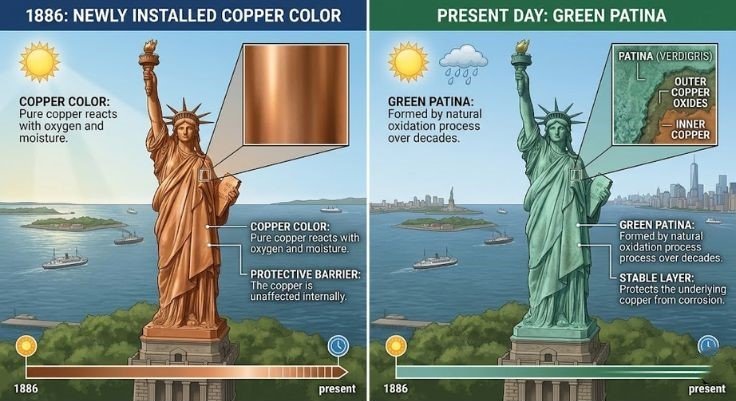
When the Statue of Liberty was unveiled on October 28, 1886, she was shiny reddish-brown the natural color of new copper. Think of a brand-new copper penny. That’s exactly what Lady Liberty looked like in her first years.
How Copper Turned Green
Over time, copper reacts with oxygen, water, and air pollutants to form a compound called copper carbonate, or patina. This chemical process is called oxidation. It took about 20 to 30 years for the statue to fully turn the blue-green color we recognize today. The change happened gradually, and there were actually proposals at the time to paint the statue to restore its original color.
Does the Green Color Protect the Statue?
Yes. The patina layer acts as a natural protective coating. It slows further corrosion and actually helps preserve the copper underneath. Removing it would expose the raw copper to faster deterioration. The green color is now considered an essential part of the statue’s integrity as well as its identity.
Height, Size, and Measurements
How Tall Is the Statue of Liberty?
The statue from the base of her feet to the tip of her torch measures 151 feet and 1 inch (approximately 46 meters). From the ground to the top of the torch, including the pedestal and foundation, the total height is 305 feet and 1 inch (approximately 93 meters). That’s roughly equivalent to a 22-story building.
Total Weight and Dimensions
The statue alone weighs approximately 450,000 pounds (225 tons). The copper skin is only about 3/32 of an inch thick roughly the thickness of two pennies stacked together. The total weight of the monument including the pedestal is over 450,000 tons when you include the concrete and granite base.

Crown, Torch, and Tablet Measurements
- The crown contains 25 windows and 7 rays
- Each ray of the crown is 9 feet long and weighs 150 pounds
- The tablet is 23 feet 7 inches tall and 13 feet 7 inches wide
- The index finger alone is 8 feet long
- The nose is 4 feet 6 inches long
- The right arm (holding the torch) stretches 42 feet
Value and Ownership of the Statue of Liberty
Who Owns the Statue of Liberty?
The Statue of Liberty is owned by the United States federal government. It is administered by the National Park Service as part of the Statue of Liberty National Monument, which also includes Ellis Island. It was declared a national monument in 1924 by President Calvin Coolidge.
How Much Is the Statue Worth?
Assigning a monetary value to an irreplaceable cultural monument is nearly impossible. For insurance and accounting purposes, the statue and its grounds have been assessed at values ranging from hundreds of millions to several billion dollars. But practically speaking, no dollar figure captures its historical, cultural, and symbolic significance.
Who Maintains the Monument Today?
The National Park Service maintains and preserves the Statue of Liberty. The Statue of Liberty–Ellis Island Foundation, a nonprofit organization, also plays a major role in funding restoration and preservation projects. The foundation raised over $350 million for the massive restoration completed in 1986 for the statue’s centennial.
Inscriptions and Hidden Details
The Poem on the Pedestal
Inside the pedestal, a bronze plaque bears the full text of Emma Lazarus’s sonnet The New Colossus, written in 1883. The most famous lines read: “Give me your tired, your poor, your huddled masses yearning to breathe free, the wretched refuse of your teeming shore.” The poem was added in 1903, 17 years after the statue’s dedication. It fundamentally changed how Americans and the world interpreted the monument’s meaning.
What Is Written on the Tablet?
The tablet reads: JULY IV MDCCLXXVI the Roman numeral date for July 4, 1776, the date the United States declared independence from Britain. Nothing else is written on the tablet. Its simplicity makes it powerful. The date alone carries enormous weight.
Hidden Symbols Most Visitors Miss
Beyond the broken chains at her feet, there are several details most visitors overlook:
- The 25 windows in the crown symbolize gemstones and heaven’s rays shining over the world
- The classical robe Lady Liberty wears is modeled on ancient Roman dress, connecting American democracy to Roman republican ideals
- The seven rays of the crown echo the rays of the sun as depicted in classical art
- The position of her feet shows she is in motion walking forward, not standing still
Visiting the Statue of Liberty
Where Is the Statue Located?
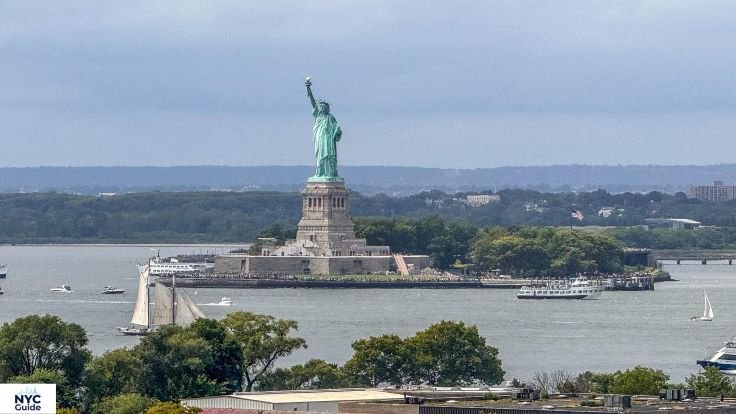
The Statue of Liberty stands on Liberty Island in New York Harbor, about half a mile from the southern tip of Manhattan and one mile from the New Jersey shoreline. The island itself is only about 12 acres in size.
How to Visit Liberty Island
The only way to reach Liberty Island is by ferry. There are two departure points:
- Battery Park, Manhattan — most popular, multiple departures daily
- Liberty State Park, Jersey City, New Jersey — less crowded, great views of Manhattan
Ferries are operated by Statue Cruises, the official concessioner. As of recent information, ferry tickets start at around $24 for adults (including access to both Liberty Island and Ellis Island). Prices may vary, so always check the official website before booking.
The ferry ride takes approximately 15 to 20 minutes from Battery Park.
Booking tip: Book tickets well in advance, especially for crown access. Crown tickets sell out weeks or even months ahead during peak season.
Can You Go Inside the Crown?
Yes, but access is very limited. The crown can only accommodate 10 people at a time, and climbing requires ascending 354 stairs (equivalent to a 20-story building) with no elevator access. Crown tickets must be booked far in advance sometimes 3 to 6 months ahead during summer.
Pedestal access is slightly easier to book. The grounds and museum on Liberty Island are accessible to all ferry ticket holders at no additional charge.
Best Time to Visit
The best time to visit the Statue of Liberty is during the shoulder seasons: late April to early June or September to October. The weather is mild, crowds are smaller than in peak summer, and wait times at the ferry are more manageable. Summer (July and August) is the busiest period expect large crowds and long queues. Early morning ferries are always less crowded regardless of season.
Duplicate Statues Around the World
The Statue of Liberty has inspired dozens of replicas worldwide, ranging from near-perfect copies to quirky smaller versions.
Famous Replicas in the United States
Several American cities have their own Statue of Liberty replicas. The most notable include:
- Las Vegas, Nevada — a half-scale replica stands outside the New York-New York Hotel & Casino
- Birmingham, Alabama — a full-sized replica was placed on top of a post office in 1956 by the Boy Scouts of America
- Hannibal, Missouri — a smaller replica stands in a town park
Statue of Liberty Replicas in France
Perhaps fittingly, France has multiple replicas of the statue it gave to America.
- Paris, Île aux Cygnes — a 37-foot replica on a small island in the Seine River, facing toward the original in New York
- Colmar, Alsace — a replica in the hometown of sculptor Frédéric Auguste Bartholdi
- Paris, Musée des Arts et Métiers — a smaller bronze model used during the construction phase
Other Countries With Lady Liberty Copies
Replicas exist in countries including Japan (Tokyo Harbor), Taiwan, Australia, Germany, and several others. These copies speak to just how powerfully the image of Lady Liberty has penetrated global culture. She has become a universal shorthand for freedom and democracy.
The Statue of Liberty in Pop Culture
Movies Featuring the Statue
The Statue of Liberty may be the single most used landmark in cinematic history when it comes to symbolism. Some memorable appearances include:
- Planet of the Apes (1968) — the iconic final scene where Charlton Heston discovers the buried statue on a ruined beach remains one of cinema’s greatest twists
- Ghostbusters II (1989) — the team animates the statue using slime to walk it through New York City
- Cloverfield (2008) — the monster famously hurls the statue’s head through the streets of Manhattan
- Superman IV (1987), I Am Legend (2007), X-Men (2000), and dozens more
The Statue in TV Shows and Media
Lady Liberty appears constantly in advertising, news broadcasts, album covers, and television as a symbol of American identity. She’s used by both sides of almost every major American political debate progressives cite the Lazarus poem to argue for open immigration; conservatives use her image to represent national sovereignty and strength. Few symbols carry that kind of versatile weight.
Why It Remains a Global Icon
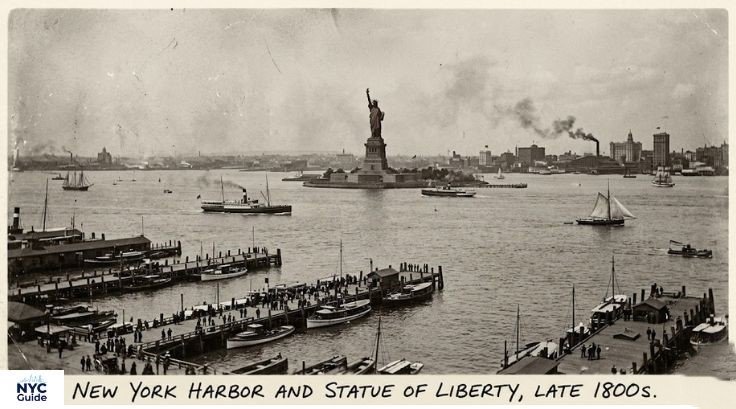
The Statue of Liberty endures as a global icon because she represents something people everywhere want to believe in: that freedom is worth celebrating and protecting. She has witnessed over a century of history from her spot in New York Harbor. Millions of immigrants first saw her as they arrived in America by ship. That emotional history cannot be manufactured it’s built into the monument itself.
25 Fascinating Facts About the Statue of Liberty
- The statue’s full name is “Liberty Enlightening the World.”
- She was dedicated on October 28, 1886.
- France gifted the statue; America built the pedestal.
- Frédéric Auguste Bartholdi designed the exterior.
- Gustave Eiffel engineered the interior iron framework.
- The copper skin is only 3/32 of an inch thick.
- She was originally a shiny reddish-brown color.
- It took about 25 years for the green patina to fully develop.
- The torch has been closed since 1916.
- She is struck by lightning about 600 times per year.
- There are 354 steps to reach the crown.
- The crown has 7 rays representing the 7 seas and continents.
- Her index finger alone is 8 feet long.
- The broken chain at her feet symbolizes freedom from slavery.
- The pedestal was partly funded through a newspaper crowdfunding campaign.
- Joseph Pulitzer used The New York World to raise pedestal funds.
- Emma Lazarus wrote The New Colossus in 1883.
- The poem was added to the pedestal in 1903.
- The statue served as a lighthouse from 1886 to 1902.
- She can sway 3 inches and her arm up to 5 inches in high winds.
- The statue was declared a national monument in 1924.
- The National Park Service manages the monument today.
- A Paris replica on the Seine faces toward the New York original.
- Thomas Edison once proposed making the statue speak via phonograph.
- The statue is recognized as a UNESCO World Heritage Site, designated in 1984.
Frequently Asked Questions About the Statue of Liberty
The Statue of Liberty was built to celebrate the friendship between France and the United States and to honor the ideals of freedom and democracy. French political thinker Édouard de Laboulaye originally proposed the idea following the American Civil War and the abolition of slavery. It was intended as a joint symbol of shared democratic values between the two nations.
The statue is green because of a natural chemical process called oxidation. The copper exterior reacted with oxygen, water, and air over several decades to form a greenish compound called patina. The statue was originally a shiny reddish-brown when unveiled in 1886. The full green color developed gradually over about 20 to 30 years.
No. The torch has been closed to visitors since 1916, following explosion damage from the Black Tom munitions sabotage in New Jersey. The narrow staircase inside the arm was deemed too unsafe for public access and has never been reopened.
The statue from feet to torch tip measures 151 feet and 1 inch. Including the pedestal and foundation, the total height is 305 feet and 1 inch roughly equivalent to a 22-story building.
France gave the Statue of Liberty to the United States. The French people funded the construction of the statue itself as a gift. Americans were responsible for building the pedestal and foundation on Liberty Island in New York Harbor.
The crown’s seven rays represent the seven seas and seven continents of the world. The idea is that the light of liberty radiates outward in all directions, reaching every corner of the earth. The 25 windows in the crown symbolize gemstones and heaven’s rays shining down on humanity.
Final Thoughts
The Statue of Liberty is far more than a tourist attraction. She is a layered, carefully constructed monument that carries a remarkable amount of history, symbolism, and human story in every detail. From the broken chains at her feet to the golden torch she holds high, nothing about her was accidental.
If you’re planning to visit, book your tickets early especially if crown access is on your list. And when you’re standing on the ferry looking up at her as you approach Liberty Island for the first time, take a moment to think about everything she represents. Millions of people before you looked at that same figure and felt something shift inside them.
That’s the real power of the Statue of Liberty facts and history. The more you know, the more meaningful she becomes.