
If you’ve ever walked along Fifth Avenue in Midtown Manhattan, you’ve probably stopped and stared at a massive bronze figure carrying the weight of the world literally. The Atlas Statue NYC is one of those landmarks that makes you pause, pull out your phone, and wonder: what is this, and why does it feel so powerful? Many visitors walk past it without knowing its full story, and that’s a shame.

This guide is here to change that. Whether you’re planning your first trip to New York or you’ve visited a dozen times, this article gives you everything you need the location, the history, the meaning, the best photo tips, and what to do nearby. By the time you finish reading, you’ll feel ready to visit with confidence.
The Atlas statue in New York City is more than just a photo opportunity. It’s a symbol of human strength, endurance, and ambition and it sits in one of the most iconic locations in the world. Let’s dive in.
What Is the Atlas Statue in NYC?
Atlas in Greek Mythology
Atlas is a figure from ancient Greek mythology. According to the myth, Atlas was a Titan one of the powerful beings who existed before the Olympian gods took control. After the Titans lost a great war against the Olympians, Zeus punished Atlas with a brutal sentence: he had to carry the heavens on his shoulders for eternity.
In most artistic depictions, including the New York version, Atlas is shown holding up a large celestial sphere representing the sky or the universe rather than the Earth itself, though many people commonly call it “the globe.” His body is bent under the weight, muscles straining, yet he stands firm. That image alone says a lot.
Symbolism of the Atlas Statue
The symbolism here runs deep. Atlas represents endurance under pressure. He carries an impossible burden and keeps going. For New York City a place built by immigrants, workers, and dreamers who carried their own impossible burdens this statue feels deeply personal.
The celestial sphere Atlas holds is made up of intersecting rings representing the equator, the tropics, and the ecliptic. It’s not just decorative. It reflects the Art Deco era’s love of combining science, beauty, and grand ideas into a single powerful image.
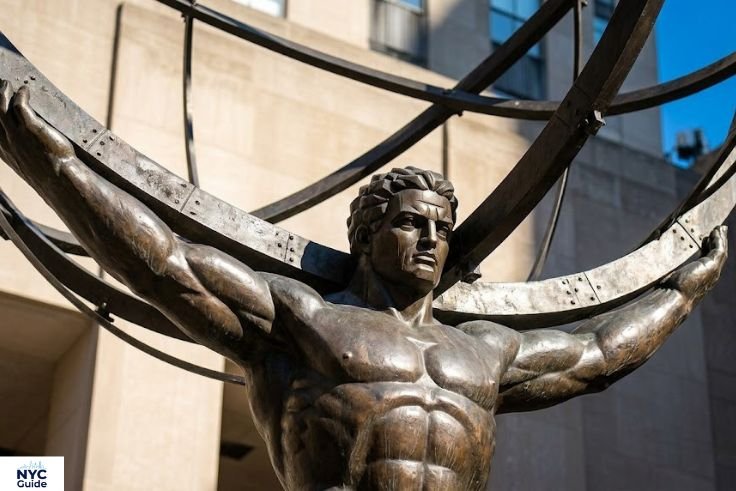
Many visitors feel an emotional connection when they stand in front of it. When I first saw it, I wasn’t expecting that reaction. But there’s something about a figure that refuses to collapse under the weight of the world that hits differently when you’re standing right in front of it.
Where Is the Atlas Statue Located?
Rockefeller Center, Fifth Avenue
The Atlas statue is located at 630 Fifth Avenue, in front of the International Building at Rockefeller Center, in Midtown Manhattan. It stands on the Fifth Avenue side of the complex, directly across the street from St. Patrick’s Cathedral.
The address is easy to find and the statue is impossible to miss. It faces east, toward the cathedral, and towers above the entrance plaza at roughly 45 feet tall including its base.
Exact Location: 630 Fifth Avenue, New York, NY 10111 Between 50th and 51st Streets
How to Get There
Getting to the Atlas statue is straightforward from anywhere in Manhattan.
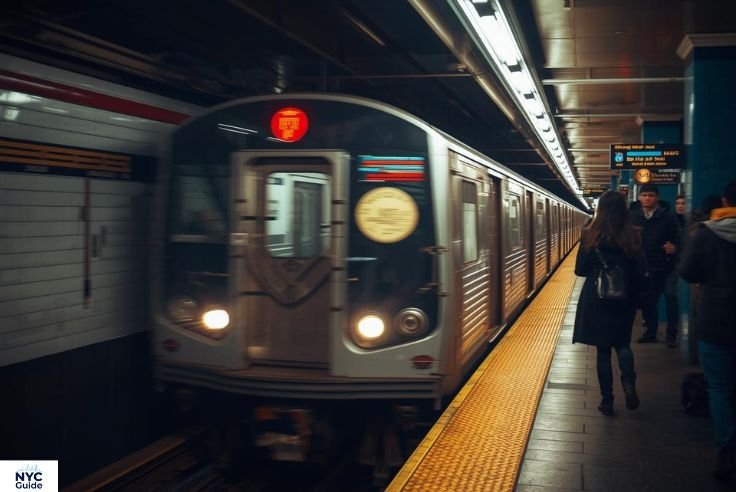
By Subway:
- Take the B, D, F, or M train to 47–50 Streets / Rockefeller Center station. Walk one block east to Fifth Avenue and turn right. The statue is right there.
- Take the E or M train to 5 Av/53 St and walk two blocks south along Fifth Avenue.
By Bus:
- M1, M2, M3, or M4 buses all stop along Fifth Avenue near 50th Street.
On Foot:
- If you’re coming from Times Square, it’s about a 10-minute walk east and south along 49th or 50th Street.
- From the Museum of Modern Art (MoMA), it’s a 5-minute walk south on Fifth Avenue.
The statue is on a public plaza, so there’s no entrance fee and no gate. You can walk right up to it any time of day or night.
History of the Atlas Statue
When Was It Created?
The Atlas statue was completed and installed in 1937. This was during the final phase of Rockefeller Center’s construction, a massive development project that began in the early 1930s during the Great Depression.
Who Created It?
The statue was created by Lee Lawrie, one of the most celebrated architectural sculptors of the Art Deco period. Lawrie designed it in collaboration with René Paul Chambellan, who assisted with the modeling work.
Lee Lawrie was already well known at the time. He had created sculptures for the Nebraska State Capitol and contributed to works across the United States. But the Atlas at Rockefeller Center became his most recognized piece.
The statue is cast in bronze and weighs an enormous amount. It stands approximately 15 feet tall on its own, though the full installation including the base reaches much higher.
Cultural Significance
The 1930s were a defining decade for American art and architecture. The Art Deco movement was at its peak combining bold geometric forms, metallic materials, and themes of progress and power. Rockefeller Center itself was a statement: even during the Depression, New York was building the future.
The Atlas statue fit perfectly into that vision. It wasn’t just decoration. It was a message. A civilization that could create something this grand, this confident, was not giving up.
Over the decades, the statue has become a defining image of Midtown Manhattan and New York City as a whole. It has appeared in films, television shows, magazine covers, and has been endlessly photographed by millions of visitors.
Why the Atlas Statue Is Famous
A World-Class Photography Spot
The Atlas statue is one of the best photography spots in all of New York City. The composition is almost too good to be true. You have the bronze figure in the foreground, the soaring Art Deco tower of the International Building behind it, and the Gothic spires of St. Patrick’s Cathedral framed perfectly in the background across the street.
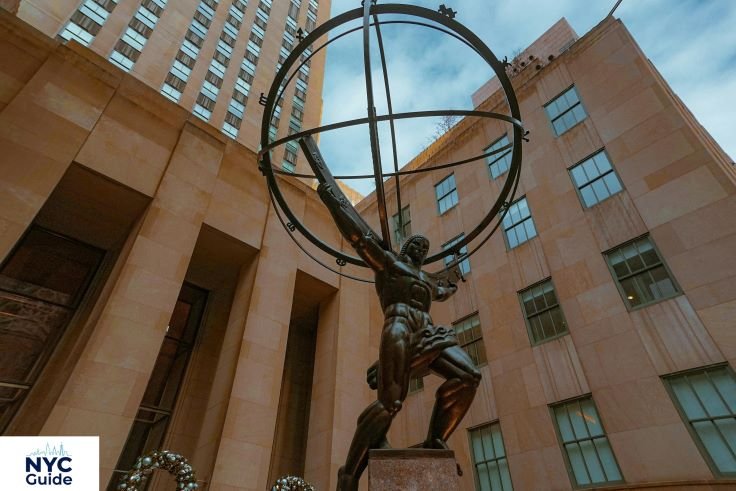
I’ve seen photographers set up here for hours trying to get the perfect shot. The interplay between the secular and sacred the Rockefeller commercial complex facing the cathedral creates a visual tension that makes every photo interesting.
Best photo tips:
- Shoot from slightly below and to the side to emphasize the upward reach of the figure.
- Early morning offers clean light and empty streets.
- The statue looks stunning at dusk when the building lights come on.
- A wide-angle lens captures both Atlas and the cathedral in one frame.
Midtown Manhattan’s Most Recognized Landmark
Rockefeller Center draws millions of visitors each year. The Atlas statue is one of the first things people see when they approach from Fifth Avenue. It anchors the entire complex visually and emotionally. Even people who don’t know the mythological story feel the weight and power of the image immediately.
It also holds a somewhat controversial place in cultural history. Novelist Ayn Rand used the image of Atlas holding up the world as the central metaphor for her novel Atlas Shrugged though Rand’s interpretation differs significantly from the original myth and the statue’s intended meaning.
Best Things to Do Near Atlas Statue
Once you’ve taken in the statue, you’re in one of the richest areas of Manhattan for sightseeing. Here’s what’s within easy walking distance.
St. Patrick’s Cathedral
Directly across Fifth Avenue from the Atlas statue stands St. Patrick’s Cathedral, one of the most beautiful churches in the United States. Built in the Gothic Revival style, its white marble spires reach 330 feet into the Manhattan skyline.
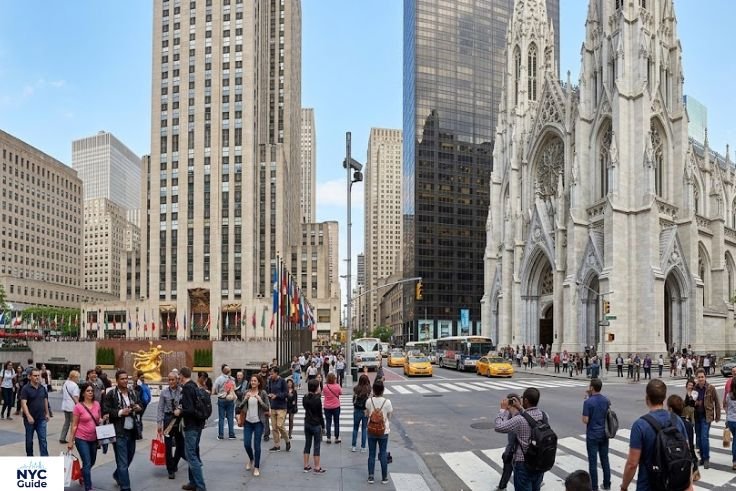
Entry is free. The interior is breathtaking stained glass windows, soaring ceilings, and a peaceful atmosphere that feels completely removed from the city outside. I always recommend spending at least 20–30 minutes inside.
Hours: Generally open daily from 6:30 AM to 8:45 PM, though hours may vary on religious holidays. Check the official website before visiting.
Top of the Rock
Top of the Rock Observation Deck is located within Rockefeller Center itself, just steps from the Atlas statue. It offers some of the best views of Manhattan, including a direct view of the Empire State Building you simply cannot get from anywhere else.
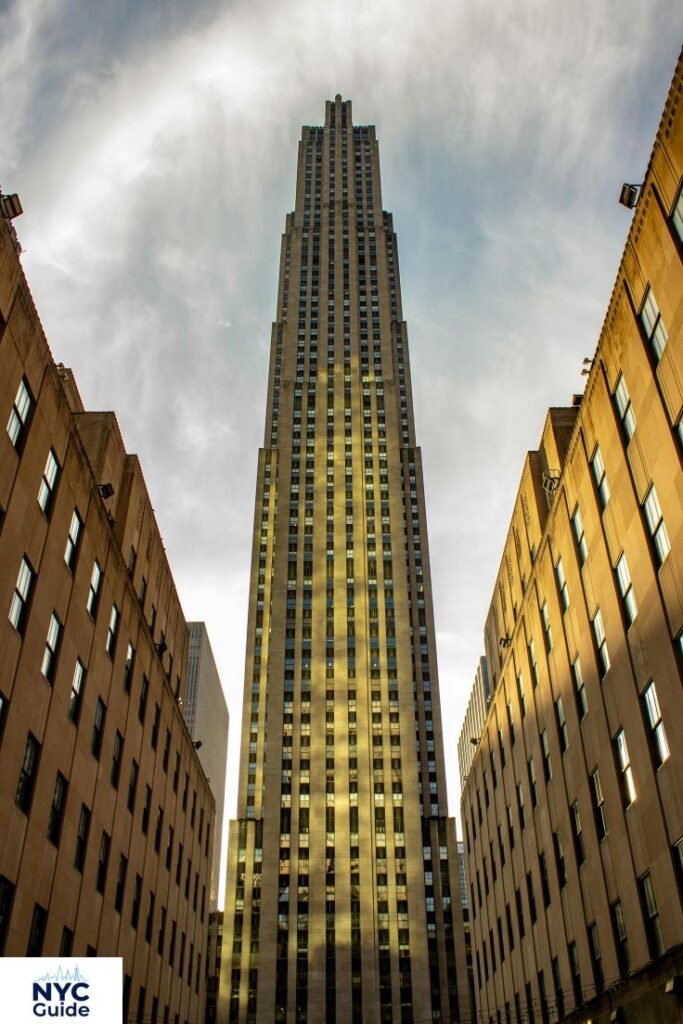
- Hours: Daily, 9:00 AM – midnight (last elevator at 11:00 PM)
- Tickets: Approximately $40–$50 for adults; children under 6 are free. Prices vary by time and season book in advance online to save money.
- Tip: The sunset time slot (about 6–8 PM depending on season) sells out fast. Book at least a few days ahead.
Times Square
Times Square is roughly a 10-minute walk west along 49th or 50th Street. It’s loud, bright, overwhelming, and completely unmissable if this is your first New York trip.

Visit at night for the full neon experience. During the day it’s easier to walk around and actually see the architecture and signage without the heaviest crowds.
The Rockefeller Center Complex
Don’t just stop at the Atlas statue and leave. The entire Rockefeller Center complex is worth exploring. The sunken plaza at the center (famous for its ice skating rink in winter and outdoor café seating in summer) is a short walk through the buildings. There are also art installations, underground shops, and rotating exhibitions throughout the complex.
30 Rockefeller Plaza
The main tower of Rockefeller Center 30 Rock is one of the finest Art Deco skyscrapers ever built. Walk around its base and look up. The decorative details on the lower floors are extraordinary. Many people rush past without noticing them.
Best Time to Visit the Atlas Statue
The Atlas statue is outdoors and accessible 24 hours a day, every day of the year. But some times are better than others.
By Season
Spring (April–June): Comfortable temperatures, longer daylight hours, and manageable crowds. One of the best times to visit Midtown Manhattan overall.
Summer (July–August): Hot and crowded. Fifth Avenue is packed with tourists. Mornings are your best bet to avoid the worst of it.
Fall (September–November): Many experienced travelers say fall is the best time to visit New York. Mild weather, beautiful light, and slightly reduced crowds compared to summer.
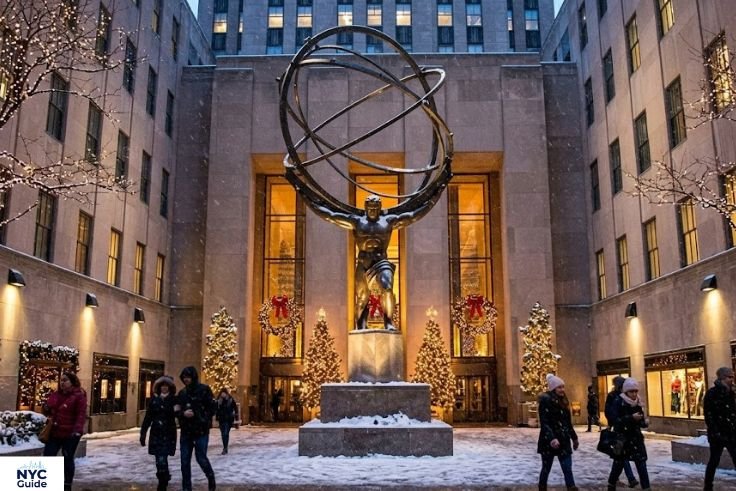
Winter (December–January): The area transforms during the holiday season. The Rockefeller Center Christmas tree is installed just a short walk from the Atlas statue. The crowds are enormous but the atmosphere is magical. If you visit in winter, come early in the morning or late at night to experience it without the midday crush.
By Time of Day
Early Morning (7–9 AM): Best for photography. Soft light, almost no crowds, and you can stand directly in front of the statue without strangers walking through your shot.
Midday (11 AM–2 PM): Busiest time. Avoid if you want a peaceful experience.
Sunset and Evening: Great light for photos. The building illumination adds drama. Slightly fewer tourists than midday.
Tips for Visitors
Here are practical tips based on real experience visiting this location:
- It’s free. The Atlas statue is on a public plaza. There’s no ticket, no entry fee, no reservation needed. Just show up.
- Wear comfortable shoes. You’ll likely be walking a lot in this part of Manhattan. The area between Rockefeller Center, St. Patrick’s, and Times Square involves a lot of pavement.
- Bring a camera or charge your phone. You will want photos. The composition here is genuinely one of the best in NYC.
- Watch for street closures. Fifth Avenue occasionally has events, parades, or film shoots that can affect access. Check local NYC event calendars if you’re visiting during a holiday period.
- Respect the space. The plaza can get crowded. Be patient when positioning yourself for photos and mindful of other visitors.
- One mistake I made: I visited at noon in August on my first trip. The crowd was impossible and the light was harsh. Go early. Seriously.
- Combine your visit smartly. Atlas statue → St. Patrick’s Cathedral → Rockefeller Plaza → Top of the Rock. That’s a perfect half-day itinerary in Midtown.
- Budget tip: The Atlas statue, St. Patrick’s Cathedral, and walking around Rockefeller Center are all free. Only Top of the Rock requires a ticket. You can have an excellent experience in this area spending almost nothing.
FAQ
The Atlas statue is located at 630 Fifth Avenue, in front of the International Building at Rockefeller Center, between 50th and 51st Streets in Midtown Manhattan.
It was created by sculptor Lee Lawrie, with assistance from René Paul Chambellan. It was installed in 1937.
Yes, completely free. It stands on a public plaza accessible at all hours with no ticket or reservation required.
Atlas is a Titan from Greek mythology condemned to carry the heavens on his shoulders. The statue symbolizes strength, endurance, and the human spirit under pressure. In the context of Rockefeller Center, it reflects the ambition and resilience of New York City.
Atlas is holding a celestial sphere representing the heavens or the universe made up of intersecting rings showing the equator, tropics, and ecliptic. It is commonly mistaken for the Earth or a globe.
Early morning on a weekday gives the best experience — soft light, minimal crowds, and perfect photography conditions.
Yes. The Atlas statue and St. Patrick’s Cathedral face each other directly across Fifth Avenue. They are less than 100 feet apart, making them an obvious pairing for any visit.
The bronze figure itself stands approximately 15 feet tall. Including its pedestal and base, the full installation reaches considerably higher.
Final Thoughts
The Atlas Statue NYC is the kind of landmark that rewards visitors who take time to actually look at it. It’s not just a big bronze man holding a ball. It’s a carefully crafted work of art that speaks to endurance, ambition, and the weight of responsibility themes that feel remarkably relevant no matter what era you’re living in.
Standing in front of it on a quiet morning, with St. Patrick’s Cathedral glowing across the street and the sounds of Midtown just waking up, is one of those New York moments that stays with you.
Go early. Look up. Take your time. This one is worth it.